Saturday, October 4, 2025
Sean "Diddy" Combs sentenced to more than 4 years in prison during emotional court scene
25% of American adults with mental illness aren't receiving treatment, report finds
Bizarre Statues of Trump, Epstein Reappear on National Mall After Being Removed by NPS
Friday, October 3, 2025
GOP lawmakers revive medical marijuana debate with new bill
KIMBERLY WETHAL

State Republicans are again attempting to legalize medical marijuana, reviving a long-sought effort to provide patients with chronic illnesses or pain another form of relief.
A bill authored by Sens. Patrick Testin, R-Stevens Point, and Mary Felzkowski, R-Tomahawk, and Rep. Patrick Snyder, R-Weston, would create a “tightly regulated” medical marijuana industry in Wisconsin, which is one of just 10 remaining states that do not allow for the medical use of marijuana. The bill would regulate the industry from seed to sale and ensure that product quality is consistent for customers, its authors wrote in a memo seeking cosponsors.
Because there are no state regulations for hemp-derived THC products, they can vary on how they’ll impact the body.
“There is no doubt that each and every one of us knows someone that has suffered through an illness and struggled to find a way to make it through each day,” the authors wrote. “Medicine is never one-size-fits-all, and it is time for Wisconsin to join the majority of the country in adding another option which may help patients find the relief they need.”
One significant aspect missing from this bill that was a dealbreaker last session was the creation of state-run dispensaries where people with severe chronic illnesses could go to receive smokeless marijuana products. That proposal died in the Senate after Republicans in that chamber said they could not get behind the idea of the state doling out marijuana.
The new proposal would allow people with chronic illnesses to get a prescription from their doctor for medical marijuana in a variety of forms. It would instruct the state Department of Health Services to create an Office of Medical Cannabis Regulation to manage the patient and caregiver registries and the Department of Agriculture, Trade and Consumer Protection to establish testing guidelines for cannabis products and oversee growing standards.
And growers and product processors would need to apply for an annual $10,000 permit and be residents of the state for at least 80% of the year. Anyone with financial ties to a cannabis testing facility would not qualify. Dispensaries, which would be private businesses, would need to pay a $5,000 permit fee.
In order for people to get a prescription for medical marijuana, which would cost $20 a year to stay on the registry, they would need to meet with a doctor with whom they have a “bona fide” relationship for an in-person evaluation. The bill would limit the qualifying medical conditions to those that are severe, including cancer, seizures, chronic pain, multiple sclerosis or any terminal illnesses with a prognosis of a year of survival or less, similar to previous bills.
Under the bill, judges would not be able to consider a valid medical marijuana prescription when deciding child support or placements, but they could still consider illegal marijuana use in those situations. And it would be illegal to discriminate against workers who use medical marijuana outside of work hours.
Gov. Tony Evers, who has advocated for the legalization of medical and recreational marijuana in his past two budgets, hasn’t yet reviewed the proposal and couldn’t say whether he’d support it, a spokesperson said. Spokespeople for Assembly Speaker Rep. Robin Vos, R-Rochester, and Senate Majority Leader Sen. Devin LeMahieu, R-Oostburg, did not respond to requests for comment.
Bills to legalize medical marijuana have repeatedly failed to make it to the finish line in recent years. In 2019, the topic resurfaced after nearly a two-decade hiatus with a bipartisan bill; in the years since, lawmakers have largely agreed on the need for medical marijuana but disagreed on how to best regulate it.
Clergy Gone Wild: Texas megachurch founder Robert Morris pleads guilty to child sex abuse charges
Thursday, October 2, 2025
Howard Lutnick: Epstein was the 'greatest blackmailer ever'
Pope Leo gets political, appears to take on the White House
Wednesday, October 1, 2025
Tuesday, September 30, 2025
Monday, September 29, 2025
Drugmakers hit deadline to cut prescription costs | Morning in America
RUSD Board considering district-wide cellphone ban
Ryan Patterson
RACINE — The Racine Unified School District is considering a potential district-wide cellphone ban.
During its business meeting Sept. 22, the district’s board approved a referral to discuss the topic at its next governance committee meeting.
The date has not yet been scheduled.
The governance committee will discuss whether RUSD “should go to a cellphone free district policy,” according to the referral.
The topic likely then will be discussed during a board work session and business meeting.
Board member Scott Coey submitted the referral.
 |
| Coey |
He said cellphones can be distracting and pose a safety issue.
“I think it’s beyond time that we do something bigger,” Coey said. “I’m done waiting for the state to do its part. I know that there will be costs. I know that there will be concerns, but I can’t expect (Superintendent Soren) Gajewski to get good results with (cellphones) distracting all of these kids.”
Board member Theresa Villar said she has noticed “a lot more momentum” regarding how cellphones “interfere with education and human development in general.”
“I think it’s worth revisiting and seeing where we need to go from here,” she said.
Existing policy
Wisconsin is one of eight states with no laws or rules regarding cellphoneuse in public schools, according to the Associated Press.
The RUSD cellphone policy is in the district codebook of rights and responsibilities: “The use of electronic devices, including but not limited to cellphones, tablets, computers, etc., is allowable ONLY with approval from school staff for instructional purposes.”
 |
| Villar |
Last school year, RUSD began more strictly enforcing cellphone limitations in high schools and middle schools in an effort to improve learning.
RUSD students cannot use cellphones during instruction time, with limited exceptions.
Efforts to address cellphone use in RUSD schools began more than two years ago.
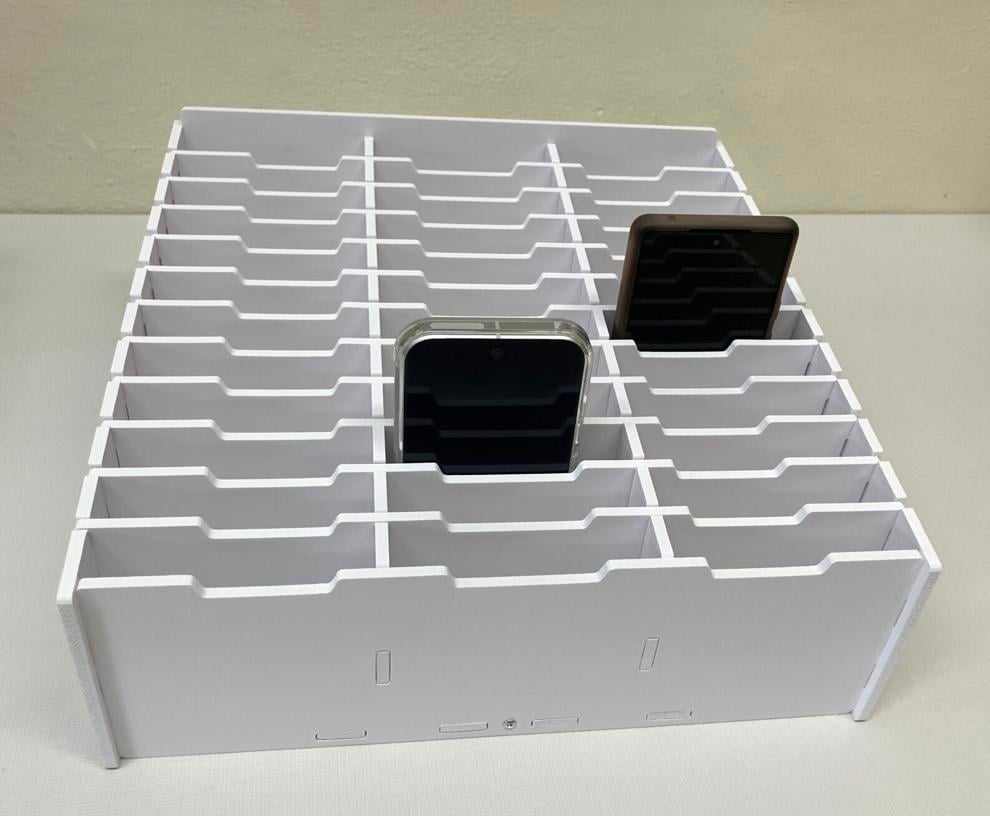 |
If a Walden school student uses a phone during instruction time, it must go into a classroom storage area. If a student is unwilling to give up the phone, it is stored in the main office in a box for the rest of the day.
In June 2023, the RUSD Board approved a referral directing administration to pursue options to remove cellphones from classrooms during the school day.
An RUSD cellphone committee was formed as a result, and then each middle school and high school formed a building cellphone committee to determine procedures.
Teachers and administrators at different buildings also met in spring 2024 to discuss potential ideas before making decisions.
Beginning near the end of 2023-24, administrators regularly informed students and families of the new 2024-25 cellphone procedures.
Schools also provided families with staff phone numbers to call if they needed to immediately reach a student at school.
The new procedures were emphasized at the start of the 2024-25 school year, with teachers and administrators explaining why they were happening.
A 2019 Pew Research Center study found that 95% of Americans ages 13-17 have access to a smartphone, with 45% saying they are “almost constantly” using the internet.
Microsoft president Brad Smith optimistic about $7.3 billion Racine County data centers
Ricardo Torres

Microsoft is making a $7.3 billion bet on data centers in Racine County -- a sum that almost surely will grow -- that it hopes will pay off in the future, despite uncertainty about the economy and AI.
“Right now, what we really strive to ensure is that Microsoft is a source of digital stability and a source of economic stability,” said Microsoft president and vice chair Brad Smith in an interview with the Milwaukee Journal Sentinel.
“And we live in a time where we all could benefit from, I’ll just say, both change and stability. Depending on how you look in the world.”
Sunday, September 28, 2025
Can I bring my underage kids to a bar in Wisconsin? Here's what the law says
Sophie Carson

It's a classic Wisconsin scene that sometimes surprises out-of-state visitors: kids hanging out with their parents in bars.
In this state, a person under 21 years old can enter an establishment serving alcohol if they're accompanied by a parent, guardian or spouse who's of legal drinking age.
But there's a bit more to the law. Here's what you need to know about Wisconsin law on underage patrons in places that sell alcohol:
Can kids and young adults under age 21 be in Wisconsin bars?
Yes, people under 21 can enter a bar or tavern with parents, guardians or spouses of legal drinking age, but it's up to the establishment and the holder of the alcohol license, according to the Wisconsin Department of Revenue.
Someone under 21 could also go into a number of other establishments with alcohol licenses, such as a restaurant, axe-throwing facility, golf course or club house, movie theater, painting studio, ski chalet or stadium.

Can kids and young adults under age 21 drink in Wisconsin bars?
Yes, people under 21 also can drink alcohol if they're with parents, guardians or spouses of legal drinking age, and if the establishment allows it.
Wisconsin isn't the only state to allow it. Many other states have similar laws, according to American Addiction Centers.
What are the fines for illegal underage drinking in Wisconsin?
Those who illegally allow underage patrons into the bar may face fines of up to $500. The underage person entering the bar unaccompanied could also face a fine of $250 to $500. Then there are additional fines for selling alcohol illegally to underage individuals, with increasing amounts, based on the number of offenses.
I grew up in bars. Until I was old enough to stay home alone, my parents took me with them. I still remember the telephone number to George's Bar. I never drank in a bar as a child, though.