
Smoke from the Canadian wildfires will hang over southern Wisconsin into Thursday, authorities said.
Improving air quality is expected to move into Wisconsin from the northwest on Wednesday, but a red advisory for unhealthy air will continue for southern and eastern Wisconsin until noon Thursday, the Wisconsin Department of Natural Resources said late Wednesday morning.
The latest information is available online.
Air quality for southern and eastern Wisconsin currently is rated as unhealthy, meaning everyone should limit their time outdoors, limit outdoor exercise and consider wearing a mask outside. People who are more sensitive to the smoke should try to stay indoors.
Read more about the weather and safety tips.
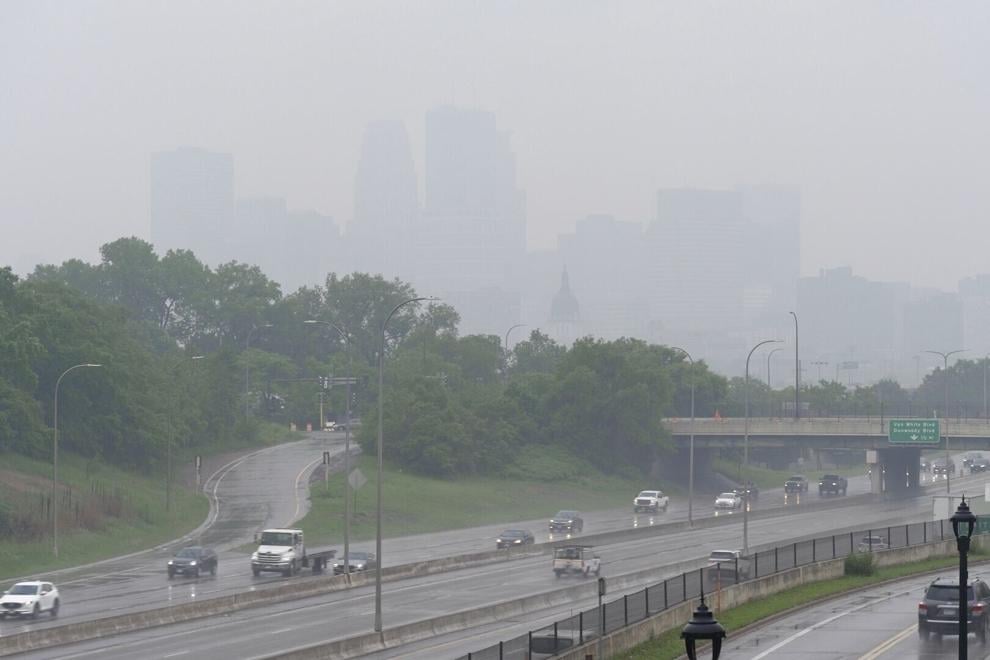 |
Smoke from wildfires burning in Canada and rain obscures the downtown skyline of Minneapolis on Tuesday. Despite rain and wind pushing through the upper Midwest, unhealthy air was expected to persist as the fires continue to burn and winds blow from the northwest to the southeast. Mark Vancleave, Associated Press |
The fires have forced more than 27,000 Canadians in three provinces to flee their homes, and the smoke has even reached Europe, the Associated Press reported.
The U.S. Environmental Protection Agency's AirNow map showed a swath of red for “unhealthy” conditions across Wisconsin and northern Iowa. Northern Michigan was also the site of many unhealthy zones, the agency said. The Air Quality Index was around 160 in many parts of the upper Midwest, indicating unhealthy conditions.
The Air Quality Index — AQI — measures how clean or polluted the air is, focusing on health effects that might be experienced within a few hours or days after breathing polluted air. It is based on ground-level ozone, particle pollution, carbon monoxide, sulfur dioxide, and nitrogen dioxide. Particulates are the main issue from the fires
The index ranges from green, where the air quality is satisfactory and air pollution poses little or no risk, to maroon, which is considered hazardous. That level comes with health warnings of emergency conditions where everyone is more likely to be affected, according to AirNow.
There were areas of reduced air quality all over the U.S. on Wednesday, with numerous advisories about moderate air quality concerns as far away as Kansas and Georgia.


 Posts
Posts


No comments:
Post a Comment