As America celebrates its 250th anniversary, we're recognizing Wisconsinites who have made unique contributions to the nation.
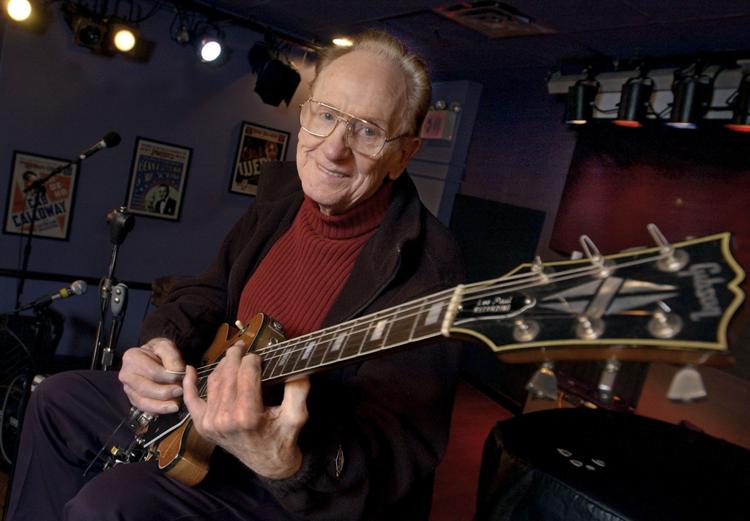
Les Paul’s home-spun inventions elevated him to a peer group that includes Benjamin Franklin and Thomas Edison.
It was Paul, nicknamed “The Wizard of Waukesha,” who helped make the sound of American Rock 'n Roll possible with his solid-body electric guitars and the recording practices he invented like overdubbing and multi-track recording.
His Gibson Les Paul Custom guitars have been favored over the years by the likes of Jimmy Page of Led Zepplin, Duane Allmen of the Allmen Brothers Band and Randy Rhoads of Black Sabbath.
Les Paul, known for his innovations on the solid body electric guitar and in multitrack recording, was born in Waukesha.
RICHARD DREW
Born Lester Polsfuss in 1915, Paul created his first electric guitar when he was a teenager by cobbling together parts from his parents’ record player. Paul dropped out of high school to join the Wolverton’s Radio Band on KMOX in St. Louis, Missouri, and by 1934 was in Chicago playing both country-western and jazz. He would later form a trio that played backup for Nat King Cole and the Andrew Sisters.
In 1941, Paul designed and built one of the first solid-body electric guitars. That led to a deal in the 1950s with the Gibson Guitar Company, which would go on to produce a guitar according to Paul’s specifications.
Paul won a Grammy in 1977 for the album “Chester and Lester,” a collection of pop-jazz guitar duets recorded with his old friend Chet Atkins.
Discovery World Museum in Milwaukee has a permanent exhibitdedicated to Paul as does the Waukesha County Historical Society & Museum. There are a series of murals throughout Waukesha honoring Paul’s life while his grave at Prairie Home Cemetery in Waukesha features a large monument with a guitar.
If more than 7 million copies sold and a public-television specialare not already enough validation of the classic status of the Violent Femmes' 1983 debut album, here's another indicator:
That album is now the subject of a book in the famed33⅓ seriesabout individual recordings.
Books in this series can vary widely from detailed music journalism to idiosyncratic personal takes."Violent Femmes"(Bloomsbury Academic) by Nic Brown, a drummer as well as a writer, is both fannish and deeply reported. Brown interviewed original band members Gordon Gano, Brian Ritchie and Victor DeLorenzo at length. He also spoke with album producer Mark Van Hecke and other figures.
Brown knows enough about how music works to ask detailed questions about riffs, notes and words. He engages band members in smart conversation about Ritchie's role as a lead bassist and DeLorenzo's use of loud-soft dynamics. But his book never flies over a non-musician's head. It's hard to imagine a fan of the album not enjoying Brown's work here.
As someone who has read many Milwaukee takes on the Femmes over the decades – and has written a few,too – I also enjoyed Brown's view of the band from outside the local hothouse.
Brown explores the band's formation, its unusual instrumentation and how it worked in the studio. He also goes over each song in detail, both lyrically and musically.
Here are a few takeaways gleaned from Brown's book. While passionate fans may already know some of these, you'd have to be a certified expert to know them all.
Bassist Ritchie coined the Violent Femmes name as a label for the rhythm section he had with DeLorenzo, at a time when the pair played with various other musicians.
By the time he met Ritchie and DeLorenzo, the prolific Gano had already written all of the songs that would appear on the Femmes' first two albums, and some of the songs that would turn up on the band's third.
What led to the Femmes' acoustic instrumentation, particularly Ritchie's acoustic bass guitar? "I just thought that we should all be equipped to play acoustic music because there was an imminent apocalypse on the horizon," Ritchie told Brown. "I thought we probably wouldn't have electricity."
The trio's first gig was in the basement-level Beneath-It-All-Cafe on Downer Avenue (under the old Wash Tub laundromat).
The person who actually "discovered" the Femmes busking outside the Oriental Theatre on the day of a Pretenders concert in 1981 was Peggy Sue Honeyman-Scott, the wife of guitarist James Honeyman-Scott. It's often written that James or even singer Chrissie Hynde was the initial talent spotter.
Who bankrolled the recording of the album? DeLorenzo's father loaned the group the $10,000 they needed.
Castle Studios in Lake Geneva, where the album was recorded, was a facility that had been installed in the main lodge of the fabled Playboy Club there.
Given the enormous backlog of songs Gano had written and the limited studio time the band could afford, how did they decide what to record for the first album? Gano said Ritchie had "the brilliant idea" to pick only "the poppy songs." That's why the band's second album, "Hallowed Ground," is so different: it has the Gano songs influenced by gospel, country and jazz.
DeLorenzo calls the distinctive snare drum beats he plays at the beginning of "Blister in the Sun" "stutter flams." A flam, Brown explains, is played with two sticks hitting one note together. Those familiar flams are heard today as pump-up music samples in stadiums and arenas around the country.
Penn Jillette, of the magic duo of Penn and Teller, gave Gano a specific and enthusiastic compliment about the timing of a line in "Kiss Off." But you'll have to read Brown's book to find out what it was.
Notes You Never Hear: The Metaphysical Loneliness of George Harrison
Of all the impossible-to-recreate sounds made by the Beatles, George Harrison’s lead guitar might be the most elusive. Jayson Greene teases out its haunting essence with the help of a few Harrison acolytes, including his son Dhani.
Recently, Dhani Harrison was rehearsing “Let It Down”, from All Things Must Pass, when a member of his band told him he was playing his own father’s song wrong. “I was doing my own solo, not the one in the song, and he couldn't take it,” Dhani laughs. “And he was right! I was fudging the chords a bit. I sighed and said, ‘OK then, let's go back and figure it out.’”
Of all the impossible-to-recreate sounds made by the Beatles—Ringo’s drum fills, Paul’s bass lines—George Harrison’s lead guitar might be the most elusive. Even his own son has spent most of his life struggling to grasp its essence. “For most of my early life, I tried not to learn my father’s music,” Dhani says dryly. He’s joking, at least partly: He has spent years preserving, protecting, and archiving his father’s legacy, and he knows every note, down to which guitar played it. In September, he oversaw the remastering and reissuing of Harrison’s first six solo records, which were recently released on Capitol as The Apple Years: 1968-1975.
So if you are looking for someone to explain the near-mystical quality of George Harrison’s guitar playing—or at least grapple poetically with its spirit—Dhani is your best bet. “My father once said to me, ‘I play the notes you never hear,’” he remembers. “He focused on touch and control partly because he never thought he was any good, really. He knew he was good at smaller things: not hitting any off notes, not making strings buzz, not playing anything that would jar you. ‘Everyone else has played all the other bullshit,’ he would say. ‘I just play what's left.’”
I just play what's left. There probably isn’t a more self-effacing way to describe it. But Harrison’s playing, both in the Beatles and in his solo work, has always sounded this way, like whatever resounding truth remained after all else was exhausted; it is an inner music. Like a chess master who stares motionless at the board while the pieces move in his mind, Harrison’s hardest work always happened before he began playing, as he painstakingly arranged and rearranged chord shapes: In her foreword to his memoir I, Me, Mine, Olivia Harrison fondly remembers her husband writing at home, one ear cocked to the side, endlessly working and reworking chord formations.
“He looked very hard for the notes that were most suggestive of the whole,” Dhani says, offering something close to a defining philosophy behind that rounded, softly glowing tone. There is something almost metaphysical about its loneliness. His lead guitar was never a “lead” in a traditional sense; it is just one voice in an imaginary choir. His lilting solo on “Something” is both foreground—you can sing every note of it—and background, as misty and distant as the orchestra behind it. You could never imagine reaching out and touching it.
Maybe it’s due to this remoteness that his style has quietly resisted cliché or aging out of fashion. Bands that would never cite rock-god contemporaries like Eric Clapton and Jimmy Page regularly namecheck him as an influence. “His chords were sometimes more a cluster of notes that, to my ears, are beautifully dissonant,” says Weezer guitarist Brian Bell, who recently took part in a massive benefit concert called George Fest. Like all Harrison acolytes, Bell’s appreciation zooms in on granular moments. “The turnaround lick over the last chord in the chorus of the Beatles’ ‘Help’ functions on many levels,” he explains. “It’s such an innovative use of the open G and B strings ringing out, while a minor 3rd shape chromatically descends below it.”
“He mixed playing chords and single-note runs similar to a jazz player,” agrees Matt Mondanile, guitarist for Real Estate. Mondanile is a similarly unshowy player, someone who seems to convey the meaning of every note he plays so completely that you occasionally forget to notice him. He hones in on the way Harrison’s lead lines wind around lead vocals. “I do that all the time,” he says. “On ‘Fake Blues’, ‘Beach Comber’, ‘Green Aisles’—basically any time an arpeggio floats around the melody, I'm playing Harrison,” he laughs.
When I ask Dhani which of his father’s guitar lines linger with him today, he points instantly to the opening of “I'd Have You Anytime” from All Things Must Pass. (“I think that's the Les Paul from ‘Gently Weeps’,” he muses.) Talking about the part, he uses the word “riff,” but it sits wrong—a “riff” is generally flashy, hard-angled, designed to snag your attention. The line on “I'd Have You Anytime”, with its hesitant dips and quavers and sudden, weightless leaps, rarely rises above a murmur. Like a lot of Harrison’s most lyrical playing, it feels more like a product of breath than hands.
This is not an accident. “When my dad was growing up, a lot of the pop music he loved had all these horn parts—Little Richard, Jerry Lee Lewis,” notes Dhani. “A lot of the great solos that he heard growing up were actually played on horns, and you can hear some of that turn up in his playing. As he got better and better, you started to hear less fret noise, and there was almost this laser-light quality to his sound—the pick disappeared.”
It is this liquid quality that is hardest to pinpoint. The tone evokes a zither, a clarinet—something more delicate, nuanced, and lyrical than an electric guitar. His style was so careful it was nearly self-annihilating—appropriate for someone so concerned with Eastern concepts of self. He was, after all, the Beatle who famously sat with Ravi Shankar and attempted to master the sitar, and although he failed to become a professional (or even passable) player—"I should have started at least [15] years earlier,” he lamented in I, Me, Mine—the study led him to new possibilities on the guitar neck. The precise string-bending on “My Sweet Lord”—that famous swan-necked swoop of a melody—would have been impossible if he hadn’t sat for three years, trying to master the “diri diri da ra da” of Shankar’s exercises. “As far as writing strange melodies and also rhythmically it was the best assistance I could have had,” he wrote.
I ask Dhani how he knows, within seconds, if a player has been directly influenced by his father. “There’s two ways,” he answers. “Not to sound like an asshole, but there’s the cheap, easy imitation, and then there’s the person who is genuinely influenced. Anyone can try and replicate that slide sound; I’ve heard it in records before and just thought, ‘God, we have to sue those guys.’ But then you’ll hear someone like Blake Mills, or—and this is a bit of an off-the-wall one—Josh Homme. I don't know if he’d be offended by my saying that”—he laughs—“but I mean it as the highest compliment.”
Ultimately, it is a kind of restraint, a way of seeing, that distinguishes Harrison’s playing. His ear was drawn to the smallest possible units of motion, his “quiet Beatle” stillness allowing for a heightened form of listening. “I’m really quite simple,” Harrison told Derek Taylor in I, Me, Mine. “I plant flowers and watch them grow...I stay at home and watch the river flow.” He was mocked, sometimes, for the self-seriousness of these statements, but this attention radiates from the center of his music. “It’s not suppression, it’s just discipline,” says Dhani. “He’s the reason no one can really cover the Beatles faithfully. The songs and the harmonies are one thing, and you can kind of work those out, but at some point there’s going to be a George Harrison solo, and that solo is usually perfect. So what do you do? If you start changing it, thinking you’re going to do something better, it’s not going to work out for you. It's hard to go in and start replacing things in those songs, because that’s the way that they are.”
Overtones is a column by Jayson Greene that examines how certain sounds linger in our minds and lives.


 Posts
Posts

