
Hide your nuts.

Here are a few of my favorites from the eclipse this morning. First up, a nice wide view of a partially eclipsed Moon over some Tucson city lights.
Now a zoomed in view.

Back to close up.
And finally, one of the last pics I got before the Moon faded from site due to the brightening sky and the increasingly eclipsed Moon.
I just posted a blog last night about tomorrow's lunar eclipse. It seems that on facebook and twitter, a lot of people are passing around a story about seeing an impossible site dubbed the selenelion. I am not quite sure this site is so impossible or even so rare and would love comments from other hardcore astronomers/atmospheric physics experts if my thinking is fuzzy or spot on here.
Okay, as I discussed yesterday, a lunar eclipse occurs when the Sun, Moon and Earth are in a perfectly straight line. Therefore, the full, eclipsed Moon should set just as the Sun rises and you don't see them at the same time...assuming Earth has no atmosphere and you have nice flat eastern and western horizons with no buildings/trees/hills etc. But this phenomena happens every month at full Moon! Even if you argue that it's rare because the Moon will be eclipsed, well, every lunar eclipse happens at sunset somewhere in the world so a selenelion happens during every lunar eclipse (of course, the world is 70% ocean so you could argue that many of them occur over water where no one can see them, but it is still not a rare phenomena).
The best I can tell this is "rare" because it is happening over a heavily populated portion of the United States.
But Earth does have an atmosphere. Due to refraction of light by Earth's atmosphere, we see the Sun rise a few minutes earlier than it should and the Moon set a few minutes later than it should. Therefore, you can see both the Sun and the full Moon in the sky at the same time even though it should be impossible if they are 180 degrees apart. This is something I have known for many years (and has been known for a long time) so no new discovery here.
So my question is, why is this such a rare event? This happens EVERY MONTH at full Moon. Even if you are at a spot on the world where the sun rises (or sets...this can happen at sunset with the full Moon rising in the east) . Yeah, this is a cool phenomena and I am trying to figure out where I can go to attempt to see it here (lots of mountains in Tucson) because I am fortunate enough to be in the right place at the right time, but it is something that happens during lunar eclipse and even every full Moon!Certain lucky people will get treated to a total lunar eclipse on Saturday, December 10th. Unfortunately for many people living in North America, the Moon will set before the total phase of the eclipse begins. For those of us in the west, the totally eclipsed Moon will set in the west as the Sun rises in the east.
Okay, quick review. A total lunar eclipse occurs when the Moon passes through Earth's shadow. That means the Sun, Earth and Moon (in that order) are in a straight line. Lunar eclipses always happen at full Moon, but not every full Moon heralds the arrival of a lunar eclipse (the Moon's orbit is tilted so most months it passes either slightly above or below Earth's shadow). A lunar eclipse is visible to everyone on the side of Earth facing away from the Sun when it occurs (in other words, on Earth's night side).
The penumbral phase (when the Moon enters the very outer part of the shadow) starts at 11:33UT (EST you subtract five hours from UT, CST subtract six, MST subtract 7, and PST subtract 8). The outer part of the shadow is not very dark so you might not notice the Moon get slightly dimmed if you weren't paying attention. The real action stars when the Moon enters the umbra, the dark part of Earth's shadow at 12:45UT. You can watch the Moon get progressively more covered until totality begins at 14:06UT. Totality ends at 14:57UT, the umbral phase ends at 16:17UT and the eclipse is totally over at 17:30UT. Here is a chart from NASA that shows where the eclipse is visible.
In Tucson, sunrise on Saturday is at 7:15am, just nine minutes after totality begins at 7:06am! In reality, the Moon may set a little earlier since there are mountains to the west. I already have my spot to watch and photograph the eclipse picked out. It will be interesting trying to photograph the setting, eclipsed Moon as the sky gets progressively brighter toward sunrise. I suspect there will be lots of great photos of the eclipsed and partially eclipsed Moon setting over scenic areas (Tucson Mountains in my case).
One thing I encourage everyone to do is follow the eclipse on twitter. I did this for last December's total lunar eclipse and it was a lot of fun. There will probably be a twitter hashtag (search for eclipse and you will find it...it might be #eclipse, #lunareclipse or something similar). People will be posting their observations, comments and pictures in real time. You can respond and converse with people about what is happening even if you can't observe it yourself due to your location or local weather conditions. For last Decembers eclipse, there were lots of people observing and conversing, many of whom I knew personally. It was like watching the eclipse with friends even though I was alone with my camera outside my townhome.
Reprinted with permission from the Half-Astrophysicist Blog.
 Apollo 17 launched on December 7th, 1972. It was the last of the six missions to successfully land on the Moon and the first to have a scientists, Harrison Schmidt (geologist), walk on the Moon. They spent more time on the lunar surface (over three days) and walking on the Moon (over 22 hours spread over three Moon walks) than any other mission.
Watching this launch is one of my earliest childhood memories. I have vague memories of other Moon missions, but this one is the most clear. It's easy to pin down since it was the only night launch. I was only four years old. I remember watching it and there was a launch delay that I remember taking a long time and that I got to stay up way past my usual bedtime to watch the launch. Boy, was I right! Now I can look stuff up and see that it was a 2 hour and 40 minute delay and Apollo 17 finally launched at 12:33am EST. I was in the central time zone so I saw the launch at 11:33pm, pretty late for a four year old to stay up glued to the television!
Gene Cernan and Harrison Schmidt landed on the Moon while Ronald Evans stayed in orbit with the command module. Next year will mark forty years since we last set foot on the Moon. We are long overdue to get back. Hello, my festive friends! How are you? Still no s-word on the ground in Racine. I’ve seen a few s-wordflakes, but nothing substantial. Hurray for us. I’ll accept a white Christmas. In fact, I’d like one. But, after that, I would be just fine with no more s-word for the winter. Let it s-word somewhere else.
 Yesterday, the Kepler team announced the discovery of a new planet: Kepler-22b. It has been widely reported in the media as Earth-like, capable of supporting life and even one story speculating if it could be our future home (I do not vouch for this being a reliable site).
So, what was really found. First, a review of how Kepler works. Kepler is basically staring at one area of the sky and monitoring the brightnesses of about 150,000 stars. If a planet is orbiting the star, there is a chance it will line up and pass directly in front of the star. Kepler will see the star get a bit dimmer for a little while (usually on the order of hours) as the planet transits (passes in front of) the star. When we say a bit dimmer, it means only one part in 10,000 or so, not very easy to detect which is one of the reasons this is a space based mission. From this information, you can tell if there is a planet there. Based on how long the transit takes, you can get an estimate of the radius of the planet (but not its mass...that requires follow up spectroscopy where you measure the stars wobble as the planet orbits it).
In order to qualify as a planet candidate, you need to see the star dim three times. First time, you know something happened but it might not have been a planet. Second time, pretty much same thing. Third time, you can say you have a planet candidate if the time between the first and second transit is the same as the time between the second and third transit. This pattern indicates the star is dimming with a regular period just like you would expect if a planet was orbiting it.
Kepler got lucky with this planet. Its first transit was detected only three days after Kepler started taking science data. The next one, 290 days later and the third, another 290 days later. The planet, dubbed Kepler-22b was found about as quick as it could be since its first transit was detected almost immediately (imagine if you missed it by one day...then you would have had to wait another 290 days! It's almost certain there are planets that were just missed).
So Kepler-22b orbits the star every 290 days. It's a little closer to its star than Earth is to the Sun, but that's okay since the star is a little smaller and not quite as bright. It sits in what is commonly called the habitable zone: a place where a planet similar to Earth could have liquid water on its surface.
There's the catch: Similar to Earth. Kepler-22b is about 2.4 times the diameter of Earth, so quite a bit bigger (that's almost 14 times the volume!) It's not clear if the planet is predominantly rocky like Earth. The planet could have a very thick or non-existent atmosphere. It could rotate way too fast or way too slow (resulting in a hot side and a frozen side). It could have its axis of rotation tipped on its side like Uranus. There are lots of ways it could be far from an Earth-like planet!
Of course this just gets astronomers excited to study it further. We can determine its mass by measuring the Doppler shift it imparts on the star as the planet orbits and hence determine if it is a rocky planet like Earth. Advanced spectroscopic techniques can be used to examine the planets atmosphere. These further studies (which you can bet are already being planned) will start to unravel some of the mysteries of Kepler-22b. I think Kepler Program Scientist Douglas Hudgins says it well, "This is a major milestone on the road to finding Earth's twin."
Lost in this hoopla is that they also announced over 1,000 new planet candidates (and that it looks like about 99% of their candidates are turning out to be planets, so they have a pretty good batting average).
The good news is that even if Kepler-22b turns out to be not quite so habitable, there are a lot more in the pipeline awaiting confirmation (looks like around 140 more, give or take a few based on where you draw the line for the habitable zone). These all need to be followed up and maybe in the next few years, we will nail down that true Earth-like planet.
Reprinted with permission from the Half-Astrophysicist Blog.
 As technology and observing techniques improve, we can measure the movements of stars and gas in galaxies farther away with more precision. Using more advanced techniques and instruments, Karl Gebhardt and graduate student Jeremy Murphy of The University of Texas at Austin have discovered a pair of black holes with about 10 billion solar masses each in galaxies over 300 million light years away!
They had to combine data from several telescopes including the 8 meter Gemini Telescope in Hawaii, the 10 meter Keck Telescope in Hawaii and the Mitchell Spectrograph on the 2.7 meter telescope at McDonald Observatory in Texas. By measuring how fast stars and gas are orbiting the black hole, you can calculate the mass of the black hole.
In spite of the amazingly large mass of the black holes, they are not large on the cosmic scale. The event horizons of these beasts (the point of no return where not even light can escape) is about 200 times the distance from the Earth to the Sun (commonly called an astronomical unit, or a.u.). And we don't need to worry about these guys...they are both over 300 million light years away (and we have a pretty good size black hole much closer to us at the center of our galaxy which we are happily orbiting right now and don't have to worry about it either!)
These black holes probably formed by the mergers of black holes in smaller galaxies and astronomers are very interested in figuring out the details of how these super massive black holes form. These black holes may be the same ones that powered quasars in the early universe but have run out of the supply of gas and dust that powered quasars billions of years ago.
Now when I first read this story it jogged a circuit in my brain that recalled a story from a couple of years ago that astronomers had found evidence that there is a limit to the size of the largest black holes. Sure enough, I quickly found that article again. Priyamvada Natarajan, an associate professor of astronomy and physics at Yale University and a fellow at the Radcliffe Institute for Advanced Study, found an upper limit for the mass of black holes at (drum roll, please!) 10 billion solar masses!
Now I am sure Gebhardt and Murphy are already hard at work looking at more galaxies and trying to find even more massive black holes and they would love to break the 10 billion solar mass rule and make astronomers rethink their ideas on black hole formation and evolution!
Reprinted with permission from the Half-Astrophysicist Blog.

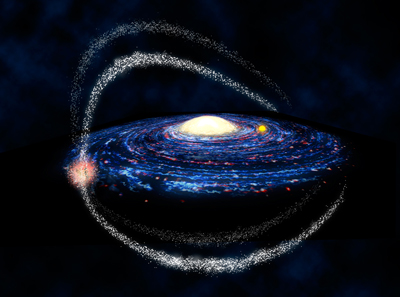 Galactic cannibalism is seen throughout the universe as large galaxies eat up and merge with smaller ones. This process plays an important role in galaxy evolution and is quite common in galaxy clusters.
 Our own Milky Way Galaxy participates in the process as well. Recently released findings from the third phase of the Sloan Digital Sky Survey (SDSS-III) have revealed two new streams of stars the Milky Way is ripping from the Sagittarius Dwarf Galaxy, a small companion galaxy of the Milky Way.
Galaxies are not solid objects, but composed of many individual stars and clouds of gas and dust. As the Sagittarius Dwarf Galaxy orbits the much larger Milky Way, some of its stars are closer to us and some are farther away. The ones close to us feel a greater tug of gravity than the ones father away. The difference in gravitational forces starts distorting the galaxy and leads to long trails of stars both in front of the smaller galaxy and behind it in its orbit. The Sagittarius Dwarf Galaxy has probably already lost about half its stars and gas to the Milky Way! Currently, the Sagittarius Dwarf Galaxy is all the way on the opposite side of the galactic center from us so it is very difficult to see.
We knew there were two tidal trails from the Sagittarius Dwarf Galaxy from previously released data. Those tails were near the north galactic cap. Now SDSS-III has released data from the southern galactic cap and Sergey Koposov and Vasily Belokurov of the University of Cambridge analyzed this data to find two new tidal streams. Interestingly, one stream is brighter than the other and appears to be composed of younger stars. Exactly how we got these two different streams with different properties is still a bit of a mystery, but we are getting a lot better at galactic interactions so you can bet people are already working on this one. One idea is that there were originally two dwarf galaxies out there interacting with each other as the Milky Way destroyed them. A collision with a clump of dark matter has also been proposed. Another idea looks at how streams can evolve over time, similar to meteor streams in our solar system.
As this galaxy continues to orbit the Milky Way, it will get ripped apart until there is nothing left but these streams of stars.
Reprinted with permission from the Half-Astrophysicist Blog.


Okay, now to Saturday, November 26th: Launch Day! Launch was scheduled for 10:02 am. We had to get to the Cape by 6:45 for the morning festivities. Plenty of activity and excitement in the air.
My group went to the media center where we got a demonstration of NASA's Eyes on the Solar System website. This site has really interesting visualization tools you can use to look at data from NASA missions. One of my favorite is recreating the flybys of various planets and moons by different missions. Definitely something I am going to spend a lot more time playing with.
We went back to the the twent where our special guests started showing up including astronaut Doug Wheelock (first astronaut to check in on foursquare from space and frequent space tweeter), Bill Nye and NASA Administrator Charlie Bolden. I joked it was getting hard to keep track of all the celebrities in the room.
And one more to come...will.i.am of the Black Eyed Peas who is an advocate for science education. It looks like he may be tweeting!
Okay, only a few minutes from launch...
We all had out our cell phones listening to the final launch poll during the last hold at t-4 minutes. Heard nothing but "go, go, go, go, go!" during the poll. Promptly at 10:02am, liftoff!
The sound of the launch takes a while to reach us. It is not as loud as I would expect, but it is very deep and you can feel those low frequencies! It is very bright at that distance., that is just as surprising as the sound. It should be noted that we were several hundred yards closer than the VIPS who were watching from the media center!
I drove aross the state to visit my father. Stopped to see some manatees (in the wild) on the way there and finished the trip with a sunset and dinner on the beach with Venus and the crescent Moon hanging low in the western sky.
Can't really say enough about the trip. NASA does a super job with these tweetups and I can't thank them enough for the experience. They are planning more so I encourage you to apply if you can. Follow their twitter account or keep an eye on the tweetup web page.
Reprinted with permission from the Half-Astrophysicist Blog.
Okay, now I am up to Friday, November 25th, the day before the launch of Curiosity. Even though this is my third blog entry, it is the first day of the official tweetup. I picked up my badge on Wednesday morning, so I could drive straight to the media center. You kind of feel special driving up to the gate at KSC and flashing your badge and them letting you drive right on site.
Even before I went to the twent (tweetup tent) I had to stop and get a picture by the famous countdown clock. The clock wasn't on yet...would take another pic the next day when the clock was actively counting down. Our twent was just across the field from the clock.
The first activity was introductions. I was really looking forward to meeting the rapper funky49. Funky49 did the Fermilab rap video I blogged about a while ago and incorporates lots of science into his music. Even if you are not a rap fan, check it out if you are a science fan. I was also thrilled to meet Tom Tomorrow of This Modern World fame. Glad to say I got to chat with both.
After introductions, there was a break to enjoy and get ready for the main tweetup event at 11am. This part was televised and featured lots of speakers from NASA and JPL who worked on Curiosity. They talked about the science they hoped to accomplish, rover design and the launch vehicle. This part was televised and you can watch it online. At a tweetup it is not considered rude to be on your laptop/cell phone/iPad as long as you are tweeting about the speaker!
One of the really cool things during this section was a rover comparison. They brought out three wheels: one from the Sojourner Rover (1997), one from the current rovers (2003) and the third one from Curiosity (2011) to illustrate how much bigger this rover is than the previous generations.
After the formal program, we had a quick lunch and then it was off to our tours of the Cape. The first stop was the Saturn V center (different buses hit the stops in different orders..there were four buses taking us on tours). I saw it on Thursday, but it is always worth a second stop.
The one I was really looking forward to was the Vehicle Assembly Building (VAB). The VAB is where they stacked the Saturn V and Shuttles. It's one of the largest buildings in the world (in terms of volume) and over 500 feet tall. Fortunately, I have a very wide angle fisheye lens for my camera, but it still cannot do the building justice!
But that's not all...there was a real treat waiting around the corner!

Next stop was Launch Complex 41 where the Atlas V stood read with Curiosity waiting for the Saturday launch.

The last stop on the tour was a little more somber: Launch Complex 34. Complex 34 is the site of the Apollo I fire that claimed the lives of astronauts Grissom, Chaffee, and White. I found the understated plaque commemorating the fire especially moving.
After the tour, it was off to dinner in Cocoa Beach. Coming back from Cocoa Beach, I stopped on the side of 528 because the pad was nicely lit up. I had to take a couple of picks at different zooms. I had no tripod, so I had to settle for steadying my camera on the hood of my car.
Yep, another full day. Had to be at the Cape by 6:45am for the launch and I was having trouble getting to sleep!
Reprinted with permission from the Half-Astrophysicist Blog.

 listen (help·info), plural haiku, is a very short form of Japanese poetry typically characterised by three qualities:


 Posts
All Comments
Posts
All Comments


