Showing posts with label Time. Show all posts

Saturday, July 4, 2026

City installs audible traffic signals, updates traffic signal timing Downtown

From The Journal Times.com:

Holly Gilvary 

The traffic signal across Main Street on Fourth lasted about 28 seconds late Thursday morning during relatively calm traffic conditions. As shown here, the audible pedestrian signal will indicate when pedestrians can and cannot cross.

RACINE — The city on Wednesday completed the installation of audible traffic signals at six intersections and implemented new traffic signal timing along Main Street between State and Seventh streets.

In a news release, the city said the two measures will improve pedestrian safety and encourage slower vehicle speeds through Downtown Racine.

The audible pedestrian signals provide locator tones and audible walk indications to assist pedestrians who are blind or have low vision in crossing the street safely, according to the city.

The updated traffic signal timing is designed to calm traffic by encouraging drivers to travel at a slower and more consistent speed. Because of the timing of the lights, drivers who try to accelerate between intersections to avoid a red light will encounter longer waits at the next signal, the city said.

The city evaluated several options in response to downtown businesses' and community stakeholders' concerns about vehicle speeds on Main Street. One alternative would have rerouted State Highway 32 off Main Street, which was estimated to cost more than $1.5 million and, according to the city, would not have directly addressed speeding concerns.
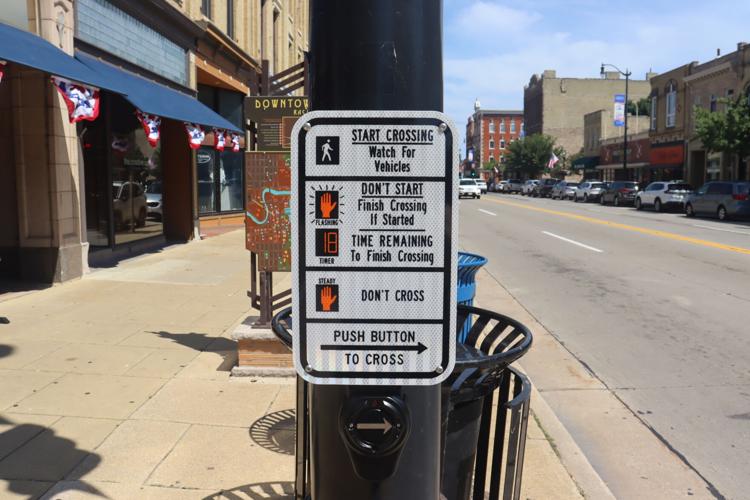
The Racine Department of Public Works installed new signage at intersections with the audible pedestrian signals, such as this one at Fourth and Main.


Previously, driving between State and Seventh streets during peak traffic periods took an average of 83 seconds. With the new traffic signal timing, the trip will take about 50 seconds longer on average, which the city said will create a safer environment for pedestrians and reduce incentives to speed through downtown. Traffic analysis found the revised timing would increase travel through the corridor to about two minutes while maintaining acceptable traffic operations.

From: https://journaltimes.com/news/local/article_48a6008d-a82f-4ab4-b099-d4c1ca27e54d.html#tracking-source=home-top-story

Monday, February 16, 2026

Is that spring in sight? Daylight saving time will be here in less than three weeks

From JSOnline:

Maia Pandey
Milwaukee Journal Sentinel

If  an early taste of spring in Milwaukee has you feeling hopeful, there's more good news: Daylight saving time is less than three weeks away.

On March 8, clocks will once again "spring forward," and the sun will set at 6:49 p.m. in Milwaukee, according to timeanddate.com

The change often reignites debates about whether daylight saving time should exist at all. Though the time adjustment allows for more daylight during spring and summer evenings, many have argued it disturbs the body's circadian rhythms and has other health drawbacks.

Here's what to know as daylight saving time approaches.

When does daylight saving time start?

Daylight saving time will resume on Sunday, March 8. Clocks will jump forward one hour between 2 and 3 a.m., meaning there will be more light in the evening and less light in the morning.

When does daylight saving time end?

Daylight saving time will end for the season on Sunday, Nov. 1, when clocks are turned back an hour at 2 a.m.

What is daylight saving time?

Between March and November, Wisconsin residents set their clocks forward by an hour to gain more daylight in the evenings. During the other four months of the year, the clocks fall back to allow for more daylight in the mornings.

Daylight saving time was enacted during World War I in an attempt to save on fuel costs by adding an extra hour of sunlight to the day. While it's a common misconception, its creation had nothing to do with allowing farmers to work longer hours, and the agriculture industry actually "fervently opposed" the measure, according to the Library of Congress.

Why do some people want to end daylight saving time?

In the decades since daylight saving time was enacted, politicians, sleep experts and farmers have all pushed to change the practice, either by eliminating daylight saving time or making it permanent year-round.

In 2020, the American Academy of Sleep Medicine said the United States should "eliminate seasonal time changes in favor of a national, fixed, year-round time." Daylight saving time disrupts the natural circadian rhythms of the human body, and the abrupt time change has been linked to increase risk of mood disorders and heart diseases, according to the organization.

From a public safety standpoint, the academy said daylight saving time also increases risk of vehicle crashes since drivers are especially sleep deprived after losing an hour of rest when the clock "springs forward."

Have there been efforts to end daylight saving time in Wisconsin?

Though some states have done away with the practice, Wisconsin continues to observe daylight saving time.

As of October 2025, 19 states have enacted legislation to observe daylight saving time year-round, if Congress were to allow such a change, and two states and several territories observe permanent standard time year-round, according to the National Conference of State Legislatures.

In Wisconsin, a bipartisan group of lawmakers introduced legislation last spring to end daylight saving time and adopt permanent standard time, but no further action has been taken on the bill.

From: https://www.jsonline.com/story/news/local/2026/02/16/when-does-daylight-saving-time-start-in-wisconsin-in-2026/88643959007/

Monday, August 12, 2024

Milwaukee won't see another sunset after 8 p.m. until May 2025

From JSOnline:

Claire Reid
Milwaukee Journal Sentinel

Although we have more than a month left of summer, the days are already getting shorter.

In fact, Milwaukee saw its last 8 p.m. sunset of the year on Saturday. The city won't see another sunset at or after 8 p.m. until May 8, 2025, according to TimeandDate.com's sunrise and sunset calculator.

So, what will Milwaukee's sunset times look like for the rest of the year? And how many hours of daylight will we see each month? Here's what to know.


How many hours of daylight are there each month?

Here is when the sun rises and sets on the first of each month in Milwaukee:

  • Aug. 1, 2024: Sunrise at 5:43 a.m., sunset at 8:12 p.m. (14 hours, 29 minutes of daylight)
  • Sept. 1, 2024: Sunrise at 6:16 a.m., sunset at 7:25 p.m. (13 hours, 8 minutes of daylight)
  • Oct. 1, 2024: Sunrise at 6:49 a.m., sunset at 6:31 p.m. (11 hours, 42 minutes of daylight)
  • Nov. 1, 2024: Sunrise at 7:27 a.m., sunset at 5:42 p.m. (10 hours, 15 minutes of daylight)
  • Dec. 1, 2024: Sunrise at 7:03 a.m., sunset at 4:17 p.m. (9 hours, 13 minutes of daylight)
  • Dec. 21, 2024 (shortest day of the year): Sunrise at 7:20 a.m., sunset at 4:20 p.m. (9 hours of daylight)
  • Jan. 1, 2025: Sunrise at 7:23 a.m., sunset at 4:27 p.m. (9 hours, 4 minutes of daylight)
  • Feb. 1, 2025: Sunrise at 7:06 a.m., sunset at 5:04 p.m. (9 hours, 58 minutes of daylight)
  • March 1, 2025: Sunrise at 6:27 a.m., sunset at 5:41 p.m. (11 hours, 14 minutes of daylight)
  • April 1, 2025: Sunrise at 6:33 a.m., sunset at 7:18 p.m. (12 hours, 45 minutes of daylight)
  • May 1, 2025: Sunrise at 5:44 a.m., sunset at 7:53 p.m. (14 hours, 8 minutes of daylight)
  • June 1, 2025: Sunrise at 5:15 a.m., sunset at 8:24 p.m. (15 hours, 9 minutes of daylight)
  • June 21, 2025 (longest day of the year): Sunrise at 5:12 a.m., sunset at 8:34 p.m. (15 hours, 21 minutes of daylight)
  • July 1, 2025: Sunrise at 5:16 a.m., sunset at 8:34 p.m. (15 hours, 18 minutes of daylight)

When does Daylight Saving Time start and end in Milwaukee?

Daylight Saving Time, the period between March and November when most Americans adjust their clocks forward one hour, ends on Sunday, Nov. 3, 2024. At 2 a.m. on Nov. 3, Americans will gain an extra hour of sleep. However, the sun will set more than an hour earlier.

On Nov. 2, the sun will rise at 7:28 a.m. and set at 5:41 p.m. in Milwaukee. On Nov. 3, it will rise at 6:29 a.m. and set at 4:40 p.m.

Daylight Saving Time will return on Sunday, March 9, 2025, shifting the sunset time from 5:50 p.m. on March 8 to 6:51 p.m. on March 9.


Switching between regular time and Daylight Saving Time is idiotic.  Leave the clocks the way that they are now.

Saturday, December 12, 2020

'I have to keep doing the work': Kenosha activist Porche Bennett-Bey honored as Time magazine 'Guardian of the Year'

From JSOnline:

Ricardo Torres
Milwaukee Journal Sentinel


Four months ago, Porche Bennett-Bey was in the streets of Kenosha, the city she grew up in, protesting the shooting of Jacob Blake by Kenosha police offer Rusten Sheskey. 

A photo from the night of Aug. 25 shows Bennett-Bey, a mom and U.S. Army veteran, holding a sign at a protest in Kenosha that read “Black Lives Matter." She stood her ground and didn’t say a word. She got tear gassed and pepper balled by police. She was nearly hit by water bottles and fireworks by protesters. But she stood her ground hoping her example of protest would lead others to do the same. 
 

Since the most intense nights of the Kenosha protests, Bennett-Bey hasn’t stopped organizing for change in her community. On Thursday her hard work was recognized. Time magazine put her on the cover as part of its "People of the Year" project. She was named “Guardian of the Year" with Assa Traoré and racial-justice organizers. 

President-elect Joe Biden and Vice President-elect Kamala Harris were both named 2020's "Person of the Year."


Read more: https://www.jsonline.com/story/news/local/milwaukee/2020/12/11/kenosha-activist-porche-bennett-bey-named-time-guardian-year/6508741002/

Tuesday, November 10, 2020

Brain Scientists Explore the How of When

A new study offers the strongest evidence yet of “time cells” in the brain.


Merriam-Webster’s defines a time warp as a “discontinuity, suspension or anomaly” in the otherwise normal passage of time; this year all three terms could apply. It seems like March happened 10 years ago; everyday may as well be Wednesday, and still, somehow, here come the holidays — fast, just like every year.

Some bard or novelist may yet come forth to help explain the paradoxes of pandemic time, both its Groundhog Days and the blurs of stress and fear for those on the front lines, or who had infectious people in their household. But brain science also has something to say about the relationship between perceived time and the Greenwich Mean variety, and why the two may slip out of sync.

In a new study, a research team based in Dallas reported the first strong evidence to date of so-called “time cells” in the human brain. The finding, posted by the journal PNAS, was not unexpected: In recent years, several research groups have isolated neurons in rodents that track time intervals. It’s where the scientists look for these cells, and how they identified them, that provide some insight into the subjective experiences of time.

“The first thing to say is that, strictly speaking, there is no such thing as ‘time cells’ in the brain,” said Gyorgy Buzsaki, a neuroscientist at New York University who was not involved in the new research. “There is no neural clock. What happens in the brain is neurons change in response to other neurons.”


Read more: https://www.nytimes.com/2020/11/10/science/brain-time-neuroscience.html