Horticulturist discusses the corpse flower blooming at the Milwaukee Domes for the next 48 hours.
Donnisa Edmonds
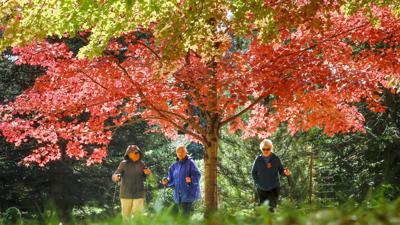
The landscapes of Wisconsin will soon be awash in the toasted reds, oranges and yellows of autumn.
If you want to make the most of your fall sightseeing but don’t know where to start, there are a few guides out there to help you find the best views.
Travel Wisconsin has an interactive map that tracks the state’s changing leaves at travelwisconsin.com.
The award-winning “Fall Color Report” is a location-by-location guide that identifies when each part of Wisconsin will be at peak color. The map also identifies the best spots for getting some picturesque autumn scenery in addition to nearby events and lodging and dining recommendations.
“As autumn advances across Wisconsin, the Fall Color Report ensures you don’t miss a moment of the beautiful but brief season,” said Tourism Secretary Anne Sayers. “The tool is designed as a one-stop shop for everything residents and visitors need to plan a memorable fall getaway.”
Currently, most of southern Wisconsin, including the Madison and Milwaukee areas, are only around 5% color, according to the map. But up north, areas around Minocqua and Rhinelander are already up to 75% color.
If you’re in southern Wisconsin and game for a drive, the 100-foot Mountain Fire Lookout Tower in the Chequamegon-Nicolet National Forest is a restored national landmark that’s one of the best places to see color in the northeastern part of the state. The tower is open until Oct. 31.
Other great spots to see color in northern Wisconsin include the Apostle Islands, the Marinette County Waterfalls and Timm’s Hill County Park in Ogema.
Another resource from Travel Wisconsin is their list of scenic fall drives around the state.
In southern Wisconsin, potential trips include a cruise along Highway 23 between Dodgeville and Spring Green.
There’s no shortage of attractions along that route, from Taliesin and House on the Rock to Governor Dodge State Park.
Another trip would run near the Wisconsin River and Baraboo Hills.
If you start in Lodi, take Highway 113 west and perhaps stop at Gibraltar Rock State Natural Area, Devil’s Lake or different attractions in Baraboo like the Circus World Museum or the International Crane Foundation.
A more ambitious journey is to follow the Upper Mississippi River Valley, a roughly 250-mile path through “charming river towns, antique shops, great cafes and stunning bluff-top views,” according to Travel Wisconsin.
For the route, Highway 35 runs from Prescott down to Potosi and is dotted along the way with observation platforms that make for great views of the river and trees.
Residents of bigger cities don’t have to travel all the way up north to see the best sights fall has to offer in Wisconsin.
The Wisconsin Department of Natural Resources has identified a list of great options both within urban areas and nearby.
In Madison, peak color is forecasted for the first week of November, according to the Fall Color Report.
In Wisconsin’s capital city, the UW Arboretum features 17 miles of trails that traverse a varied terrain of woodland, restored prairies and wetlands.
The horticulture collection within the arboretum offers a global collection of trees and shrubs in addition to the state’s largest woody plant collection.
Don’t forget what a good climb up can accomplish, either.
The observation deck of the state Capitol has a panoramic view of the Isthmus, the lakes and their plush shorelines.
A fairly short drive from Madison will take you to Janesville’s Rotary Botanical Gardens, Rib Mountain State Park just outside of Wausau or even Grandad Bluff in La Crosse.
In Milwaukee, there’s the Forest Home Cemetery and Arboretum, the largest green (and soon, red and gold) space in the city.
Other communities offer materials to assist you in a self-guided tree walking tours. Those include Cedarburg’s Trees of Distinction walk and Hudson’s five Tree Treks.
 |
A rare, 25-foot-tall Algonquin Pillar Swiss Mountain pine tree was cut down and stolen from the UW Arboretum sometime between Nov. 5 and Monday. Its twin, right, was left unharmed.
Unlike the more populated parts of Madison, the UW Arboretum is not blanketed with surveillance cameras, and presumably it doesn’t have its own Lorax to speak for the trees.
So UW-Madison officials are seeking the public’s help in finding whoever went into the Arboretum between Nov. 5 and Monday, cut down and carted away a rare, 25-foot-tall Algonquin Pillar Swiss Mountain pine tree, and cut off a 12-foot section of a Compact White Fir tree but left it on the ground.
The curator of the Arboretum’s Longenecker Horticultural Gardens, David Stevens, discovered the damage Monday. He said it’s likely the thieves “shopped around” for their targets during the warm weather over the weekend.
The Algonquin was “most likely taken for a large Christmas tree display,” he said. “Somebody’s trying to make a buck.”
 Finally, some good news for 2020 — at least if you like carnivorous plants.
 |
A hungry bumble bee cuts a hole in a leaf, stimulating the plant to flower early.
|


 Posts
All Comments


