Sunday, January 11, 2026

Thursday, November 13, 2025
Monday, October 6, 2025
Wednesday, September 24, 2025
Marijuana is illegal in Wisconsin, so why do other THC products get a pass?
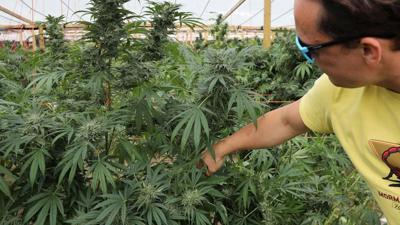
Most people know you can’t legally consume marijuana in Wisconsin, regardless of whether it’s for medical or recreational purposes.
So what’s with all those “legal weed” billboards along the highways, and how are these shops advertising delta-8 products in their windows still allowed to sell the cannabis compound?
Put simply: Because unlike delta-9, the main psychoactive compound in marijuana, other compounds like delta-8 are not regulated by the state. When concentrated and altered, these compounds can produce a similar effect on the body as pot, if only a slight one.
Most delta-8 also comes from hemp, which is legal to grow in Wisconsin.
What’s the difference between marijuana and hemp?
Marijuana and hemp are the same plant, cannabis sativa. But whether it’s legally considered marijuana or hemp comes down to how much THC, or delta-9, the plant contains. The current limit for the amount of THC content for hemp is 0.3%, which is a trace amount, UW-Madison professor of pharmaceutical history Lucas Richert said.
To keep the crop’s THC within the legal limits, farmers have to stay vigilant. Typical plant stressors like droughts, floods or temperature extremes can lead to spikes in THC content.
If the percentage of THC is higher than 0.3%, it’s considered marijuana and becomes illegal to sell. Farmers whose crops contain a percentage higher than the legal limit have to destroy them — sometimes, ironically, by burning them. Crop insurance often doesn’t cover losses when the THC potency is too high.
Assuming the THC level in the hemp is within limits, the buds can then be turned into CBD oil or further processed into compounds like delta-8 or THC-V.
Why is hemp now legal?
Hemp had been a staple crop in Wisconsin for more than 100 years before the federal government decided to regulate cannabis plants, Richert said.
But by the 1930s, most states had some form of regulation for marijuana. The federal government first put regulations and taxes on the plant in 1937 under the Marijuana Tax Act. The law allowed the government to charge an annual tax of $24 (about $551 in today’s dollars).
While the taxes were meant to reduce the amount of recreational marijuana use, they also decimated the industrial hemp industry. In 1957, the last legal hemp crop was grown in Wisconsin. By the 1970s, the federal government had listed marijuana as a Schedule I drug, an illegal drug with no accepted medical use and highly susceptible to abuse.
That all changed in 2018, when the federal farm bill carved out a legal definition for hemp for the first time, Richert said. The bill only set a legal limit for delta-9, however, leaving the plant’s other isomers and compounds, such as delta-8 and delta-10, legalized and unregulated at the federal level. In creating the definition of hemp, federal lawmakers set the legal limit of THC at 0.3%.
“It's been very recently that people are starting to think about closing some of those loopholes,” Richert said.
What’s the difference between all of these cannabis products on the market?
Delta-9 remains the main psychoactive compound people think of as marijuana, and is illegal in Wisconsin.
But by extracting cannabidiol from hemp plants and subjecting it to chemical reactions in a lab, called isomerization, scientists can rearrange the molecular structure of cannabidiol to create compounds like delta-8, delta-10, THC-V and THCA.
“You're one molecule away from a misdemeanor,” Richert said. “Those chemical differences are tiny, but they can mean really big legal consequences.”
Are compounds like delta-8 safe to consume?
Each of the products extracted from hemp plants can have differing effects on the body, and testing on those products is often less rigorous than traditional marijuana products, Richert said. In general, the psychoactive effects are milder, meaning the high and other side effects someone might feel are less pronounced than if they were ingesting marijuana.
The federal Centers for Disease Control says consumption of cannabis-related products is not risk-free. A de-regulated market without testing standards makes it more difficult for consumers to know whether what they’re consuming is safe.
The biggest misconception Richert sees around the THC market is that all of the different products with varying CBD derivatives will have the same effect on a person.
Two delta-8 products made by two different companies could have different impacts on a person because there are no testing standards.
“It's really important that the consumer have a good understanding of variability in the marketplace and that they are seeking to understand the type of products that they're they're purchasing outside of a regulated cannabis market,” Richert said. “Because we don't have a regulated personal use market in the state, we don't have a really robust way of protecting the consumers.”
What is the state doing to regulate any of this?
Lawmakers on both sides of the aisle have attempted to regulate these products.
Democrats like Gov. Tony Evers would like to see marijuana legalized and regulated for both medical and recreational use, with Evers having attempted to include it in recent budget proposals.
Republicans in the Legislature got close to allowing medical marijuana for people with chronic illnesses like cancer last session, but infighting on how to regulate it stalled the bill. Senate Republicans balked at the idea of state-run dispensaries through the Department of Health Services, arguing that was not the government’s responsibility.
Two-thirds of Wisconsinites believe marijuana should be legalized, a Marquette Law School poll from June showed.
Saturday, September 20, 2025
Wednesday, September 10, 2025
Thursday, August 21, 2025
Tuesday, July 15, 2025
Milwaukee council places age restrictions on the sale of delta-8, other hemp products
Wisconsin has no age restriction on the sale of hemp products, but after an incident from August of 2024 in which two children were hospitalized after being sold "THC gummies," city officials have found a way to crack down on the sale of hemp-derived THC products.
Common Council members backed a proposal July 15 to restrict the purchasing of hemp-derived products to anyone under 21 years old.
Those include products with names such as delta-8 and delta-10 — chemical cousins to marijuana. The legislation does not apply to "any non-intoxicating cannabinoids," including CBD.
To hold establishments accountable, anyone violating the ordinance would receive a citation ranging from $400 to $1,000. They could also be prosecuted for the offense.

An investigation last year by the Milwaukee Journal Sentinel, The Examination and AL.com found the products are causing a sharp rise in reports of children and adults getting sick. Those findings are alarming doctors and public health researchers.
Such products can be traced to Congress' legalization of the sale of hempdelta-9 and products extracted from it in the 2018 Farm Bill. Hemp is a type of cannabis plant with low levels of the psychoactive compound that gets people high, known as delta-9 THC.
A city committee voted unanimously to support the legislation earlier this month, and now that Common Council backed the potential ordinance, Mayor Cavalier Johnson would need to sign off before it can be enacted.
Monday, July 7, 2025
Milwaukee council committee backs regulating chemical cousins to marijuana, including delta-8
Alison DirrSophia Tiedge
It was August 2024 when two kids arrived at Children's Wisconsin, having snacked on newly purchased gummies before the woman caring for them realized what they had eaten was not an innocuous sugary candy.
As the children wandered through a convenience store while the woman shopped, they were munching on what was later described as "THC gummies."
She told police the candy looked just like what they normally got in grocery stores, down to the Trolli branding. When she realized what they were eating, she took them directly to the hospital.
The store clerk told police he gave the candy to the woman after she purchased it, though surveillance video showed the clerk getting the gummies from under the counter and handing them directly to the two children, according to a Milwaukee police report.
Alderperson JoCasta Zamarripa was alarmed that police could not issue a citation because there is no age restriction in Wisconsin for hemp products, including on the sale of those that can get users high.
"The truth is that he was within his rights to hand those gummies to a child," Zamarripa said of the clerk on May 20, when the store owners came before the Common Council's Licenses Committee, which she chairs.
Manwinder Singh Bhagat, one of the owners of Rama Foods, 6730 W. Villard Ave., told the committee he believed there was a miscommunication. The employee had been fired, he said, and the store sells such products only to people over 21, as listed on some of the packages.
Now, council members led by Zamarripa and Alderman Peter Burgelis want to see that minimum age become more than optional in Milwaukee.
"There was no violation of city ordinance or state law; it is wholly unregulated," Burgelis said during a July 3 meeting of the council's Public Safety and Health Committee. "This ordinance will fix that and give an age restriction to these products."
Milwaukee council members seeking minimum age for delta-8, other hemp derivatives
Council members have put forward legislation to prohibit selling or providing hemp-derived THC products to anyone under 21 years old.
Those include products with names such as delta-8 and delta-10 — chemical cousins to marijuana. An investigation last year by the Milwaukee Journal Sentinel, The Examination and AL.com found the products are causing a sharp rise in reports of children and adults getting sick. Those findings are alarming doctors and public health researchers.
Such products can be traced to Congress' legalization of the sale of hemp and products extracted from it in the 2018 Farm Bill. Hemp is a type of cannabis plant with low levels of the psychoactive compound that gets people high, known as delta-9 THC.
The city legislation would carry fines of between $400 and $1,000.
It does not apply to "any non-intoxicating cannabinoids," including CBD.
The committee backed the ordinance, which is expected to go to the full Common Council for a vote at its July 15 meeting.
Alison Dirr can be reached at adirr@jrn.com.
From: https://www.jsonline.com/story/news/politics/2025/07/07/milwaukee-council-committee-backs-regulating-delta-8/84430410007/



 Posts
Posts

