Sunday, July 19, 2026

Tuesday, June 30, 2026
Wauwatosa business calls for lawmakers to save hemp
Gina Lee Castro
A heat wave didn't stop hemp supporters from rallying to save the industry in Wisconsin June 29. Erin Kelly, the owner of Kelly's Greens Cannabis Boutique and Cafe in Wauwatosa, hosted a "Save Hemp Rally" to raise awareness of the incoming hemp ban and pressure state lawmakers to take action.
"We're all here to ask for a state plan from the state of Wisconsin," Kelly told the crowd, which spent the evening enduring a heat index around 100. "We need to protect not only 3,500 jobs but a $700 million industry [in Wisconsin]."
Late last year, President Donald Trump signed a strict set of federal hemp regulations into law – effectively banning most hemp products sold throughout Wisconsin and the U.S. Hemp gummies, vapes and flower products – no matter the type of THC – will be limited to 0.4 milligrams of THC per container. This law goes into effect in November.
Both Republican and Democrat state lawmakers proposed bills that would keep hemp legal in Wisconsin, but none made it over the hill. Lawmakers couldn't agree on how to regulate the largely unregulated industry before the legislative session closed. State law doesn't have age restriction for hemp, set packaging requirements or require product testing.

Kelly says her cafe – along with other Wisconsin hemp businesses – will have to shut their doors in November. But Kelly hasn't given up hope.
She said lawmakers told her they’re deep in campaign season and can't pass hemp laws until January 2027. She invited Milwaukee and Milwaukee County officials, gubernatorial candidates and others running for office to the rally to develop a plan to be ready by then.
Rep. Robyn Vining, D-Wauwatosa, one of the speakers, says chief of her concerns are protecting children. She says children shouldn't be able to purchase hemp products and products shouldn't look identical to candy – an issue she's heard from the Wisconsin Poison Center. However, some hemp businesses like Kelly's Greens require customers be 21 years or older to purchase.
"Let's legalize, let's regulate and let's protect Wisconsin kids," Vining said.
Supporters say hemp is medicinal, an alternative to alcohol
If hemp becomes illegal, Andy Boinski, 35, will lose his job as a hemp sales representative. Kaytlin Lovely, 29, his partner, will lose her medicine. They hope events like this rally will challenge the stereotypes around hemp.
"People aren't using this just to get high and sit on the couch," Boinski said. "People are using these for health reasons like anxiety, pain relief and chronic illnesses."
Lovely says hemp gummies give her relief from the nausea and vomiting that comes with her Cyclic Vomiting Syndrome. Her prescribed medications aren't as effective as hemp, she said.

Jake Noggle, 34, and Miranda Zielinski, 31, say Kelly's Greens hemp business brought life to a long-vacant building on West North Avenue in Wauwatosa and partnered with local businesses like Venture Brew Co.
The couple isn't a fan of drinking alcohol. Noggle says Wisconsin could stand to drink less.
"Alcohol is substantially more dangerous in overconsumption here," Noggle said. "It's nice to see an alternative."

THC seltzers, on the other hand, is one way they can still enjoy the bar scene. These drinks give them a buzz without that hangover.
"In our 30s, hangovers are not good anymore," Zielinski said. "They're like a two-day thing now."
Gina Castro is a Public Investigator reporter. She can be reached at GCastro@usatodayco.com.
Friday, June 26, 2026
Friday, April 10, 2026
Is driving with hemp or THC legal in Wisconsin? OWI rules to know
Gina Lee Castro
Hemp and its many intoxicating products have been legal in Wisconsin for eight years. But driving around with hemp products could still put you in hot water with the law, said Milwaukee attorney Andrew Mishlove.
Hemp looks and smells identical to marijuana, and both come from the Cannabis sativa L plant. But hemp is legal – for now – and marijuana is not.
When hemp users drive with these products in their cars, a police traffic stop can spiral into citations or even jail time, said Mishlove, who specializes in defending people charged with operating while intoxicated.
“It’s a mess,” he said. “Hemp is legal. Wisconsin law hasn’t caught up with that reality at all.”
Here's what we learned about why hemp can still put Wisconsin drivers at risk of an OWI.
Is it legal to drive with hemp in my car in Wisconsin?
Yes, but it’s a risk, Mishlove said.
If police officers catch a whiff of weed from a car or see it in the car, they can easily gain probable cause to make an arrest for possession of a controlled substance or begin an investigation into operating while intoxicated, Mishlove said.
Overall, state law doesn't say much about driving with hemp. Wisconsin doesn’t have an open container law for hemp the way it does for alcohol, Mishlove said. Nor is there a limit on how much hemp an individual can possess, or any laws on how drivers can lawfully transport hemp.
In contrast, in Illinois, where cannabis is legal, the product must be sealed in a child proof container and inaccessible to the driver.
Is it illegal to drive with hemp in my system in Wisconsin?
Yes. Wisconsin law does not allow drivers to have any THC in their blood. Any amount above one nanogram per milliliter is considered evidence of operating while intoxicated.
Although hemp is restricted to trace amounts of THC - the component in cannabis that makes users feel high - some products contain THC in amounts comparable to states where marijuana is legal.
In fact, a recent Milwaukee Journal Sentinel investigation found that many hemp products in Wisconsin contain THC above the federal legal limit, with consumers none the wiser. Some gummies and drinks below the federal legal limit still packed over 10 milligrams of THC per serving.
In addition, some hemp products contain a compound known as delta‑8 THC that is so similar to traditional THC that it appears chemically indistinguishable in blood testing, Mishlove said.
The THC blood test has been criticized by some scientists and lawmakers who say the limits are arbitrary and do not necessarily constitute impaired driving.
How does law enforcement determine impairment?
The Wisconsin State Laboratory of Hygiene conducts blood testing for law enforcement agencies across the state. Kayla Neuman, director of forensic toxicology, said the test cannot determine whether a person is impaired, nor can it show when THC was last consumed. The test only confirms that THC is present in a person’s system.
Neuman said observations from officers and results from roadside impairment tests contribute to evidence of impairment.
Chronic, daily THC users are more likely to have detectable levels of THC in their blood at all times and can exceed the one‑nanogram legal threshold, Neuman said.
But due to Wisconsin's zero-tolerance policy, people can be charged with an OWI even if they are sober, Mishlove said.
“It doesn’t matter whether you are impaired or high on this stuff or not,” he said. “You can’t have it in your system and drive.”
What are the laws in other states around THC and driving?
The Michigan Impaired Driving Safety Commission has said there is no scientifically supported threshold of THC in the body that proves impairment. As a result, Michigan doesn’t have a legal limit for THC. Instead, a series of roadside sobriety tests must prove the driver is impaired.
In some states where marijuana is legal, like Illinois and Colorado, the limit is five nanograms of THC, to account for chronic users.
How can hemp users in Wisconsin steer clear of legal trouble?
If you're a hemp user and plan to drive, try to keep documentation on you.
For example, Milwaukee Police Lt. Matthew Kaltenbrun said showing officers a certificate of analysis – a third-party lab test of the specific hemp product – is good evidence that the product in question is hemp, not marijuana.
Mishlove added that keeping the product's original packaging and receipt of purchase can prove the product was bought legally in Wisconsin.
As for how frequent users can prove they aren't currently impaired by THC, that's a tricky one.
"I advise people to not break the law," Mishlove said. "The law says don't drive with a restricted substance in your system. Don't use those products and drive in Wisconsin."
Gina Castro is a Public Investigator reporter for the Milwaukee Journal Sentinel. She can be reached at gcastro@usatodayco.com.
Tuesday, March 31, 2026
Friday, March 13, 2026
37% of cannabis poisonings in Wisconsin involved children under 5
Gina Lee Castro
Most calls to the Wisconsin Poison Center about edible cannabis poisonings in 2025 involved children and teens.
According to Bre Campbell, a spokesperson for the center, 68% of the 309 calls the center received about cannabis poisonings last year involved people under 19 years old.
Children under 5 accounted for 37% of the calls. This age group often mistakes THC-infused edibles as candy and can eat multiple pieces or even the whole bag, Campbell said.
“That’s a dangerous scenario,” Campbell said.
According to Campbell, about 8% of calls related to edible cannabis resulted in patients being admitted to critical care.
Starting in November, most hemp products will become illegal nationwide due to a federal ban.
Until then, hemp products with low levels of THC are legal in Wisconsin. However, a recent Milwaukee Journal Sentinel investigation that tested 30 hemp products in Wisconsin found 18 of them contained THC above the federal limit.
Among older children and teens ages 6 to 19 years old, street drugs and stimulants like THC and nicotine were the fourth most common substances involved in poisonings in Wisconsin last year.
Thirty-one percent of calls related to edible cannabis involved 6- to 19-year-olds, Campbell said.
Adults 20 years or older accounted for a similar share.
Children under 5 years old are frequently exposed to nicotine, too. About 86% of poisoning calls related to e-cigarettes and liquid nicotine in 2025 were for children under 5 years old, Campbell said.
The best thing parents and guardians can do to avoid these exposures is store these substances safely locked away and have discussions about the risks of using things like nicotine and cannabis and other drugs, Campbell said.
Contact the Wisconsin Poison Center at 1-800-222-1222 or at www.wisconsinpoison.org.
Gina Castro is a Public Investigator reporter. She can be reached at GCastro@usatodayco.com.
Thursday, February 19, 2026
Nobody knows if Wisconsin hemp products are safe or legal. So we tested them.
Gina Lee Castro

Wednesday, February 18, 2026
Thursday, February 12, 2026
Sunday, January 11, 2026
Friday, December 26, 2025
Trump reclassifies marijuana as less dangerous drug. What does it mean for Wisconsin?
Maia Pandey
In a major change to federal marijuana policy, President Donald Trump signed an executive order in December to classify marijuana as a less dangerous substance.
On Dec. 18, the president ordered the government to reclassify marijuana as a Schedule III drug. Since the Controlled Substances Act of 1970, marijuana has been classified as a Schedule I Drug, or drugs for which there are no accepted medical use and which have a high potential for abuse.
Other Schedule I Drugs include heroin, ecstasy and lysergic acid diethylamide (LSD), according to the U.S. Drug Enforcement Administration.
Though the order shifts a decades-long precedent in marijuana policy, it will not immediately impact marijuana laws in Wisconsin, where the drug remains illegal for recreational and medicinal use.
Here's what to know about the federal reclassification of marijuana and the latest on cannabis policy in Wisconsin:

What does Trump's executive order do?
Trump's order does not automatically reclassify marijuana as a Schedule III drug, but rather directs the Department to Justice to "take all necessary steps to complete the rulemaking process" for the reclassification.
In other words, Trump is ordering the government to expedite reclassifying the drug. The efforts to change marijuana's Schedule I designation began in 2022 under President Joe Biden's administration.
Trump's order also announced the administration would work with Congress to update the statutory definition of hemp-derived cannabinoid products in an effort to increase access to CBD products.
Is marijuana still illegal on a federal level?
Yes, marijuana is still illegal on a federal level.
However, the reclassification could lower tax burdens for marijuana firms, accelerate research on the drug and standardize drug development, USA TODAY reported. Companies making Schedule III drugs get a business-tax break that companies making Schedule I drugs do not.
Is marijuana legal in Wisconsin?
Recreational and medicinal marijuana use remain illegal in Wisconsin for all ages.
Efforts to legalize medicinal marijuana in Wisconsin have repeatedly failed. Meanwhile, 40 other states have legalized medicinal marijuana, and 24 states have also legalized marijuana for adult recreational use, according to the National Conference of State Legislatures.
Are hemp-derived THC products legal in Wisconsin?
Hemp-derived THC products are currently legal in Wisconsin, but that may change soon under new federal restrictions.
In 2018, a loophole in the federal Farm Bill legalized the sale of intoxicating hemp products nationwide, including in Wisconsin. Hemp-derived THC is technically different from marijuana-derived THC, but both are derived from the cannabis plant and have similar intoxicating effects.
However, in November 2025, Trump signed a federal funding bill with a provision that closes the Farm Bill loophole. The new restrictions are due to take effect one year after the bill's signing.
What is a Schedule 3 drug?
Schedule III drugs have a "moderate to low potential for physical and psychological dependence," and are essentially less dangerous than Schedule I and II drugs, per the Drug Enforcement Administration.
Other Schedule III drugs include ketamine, anabolic steroids, testosterone and products containing less than 90 milligrams of codeine per dosage unit, such as Tylenol with codeine.
Saturday, November 15, 2025
Friday, November 14, 2025
THC gummies and drinks face ban under provision in government spending bill
Thursday, November 13, 2025
Wednesday, November 12, 2025
Milwaukee THC debate; homicide prompts renewed call to outlaw products | FOX6 News Milwaukee
Friday, October 3, 2025
GOP lawmakers revive medical marijuana debate with new bill
KIMBERLY WETHAL
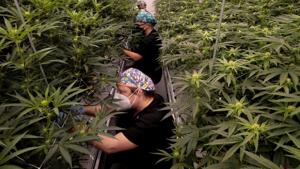
State Republicans are again attempting to legalize medical marijuana, reviving a long-sought effort to provide patients with chronic illnesses or pain another form of relief.
A bill authored by Sens. Patrick Testin, R-Stevens Point, and Mary Felzkowski, R-Tomahawk, and Rep. Patrick Snyder, R-Weston, would create a “tightly regulated” medical marijuana industry in Wisconsin, which is one of just 10 remaining states that do not allow for the medical use of marijuana. The bill would regulate the industry from seed to sale and ensure that product quality is consistent for customers, its authors wrote in a memo seeking cosponsors.
Because there are no state regulations for hemp-derived THC products, they can vary on how they’ll impact the body.
“There is no doubt that each and every one of us knows someone that has suffered through an illness and struggled to find a way to make it through each day,” the authors wrote. “Medicine is never one-size-fits-all, and it is time for Wisconsin to join the majority of the country in adding another option which may help patients find the relief they need.”
One significant aspect missing from this bill that was a dealbreaker last session was the creation of state-run dispensaries where people with severe chronic illnesses could go to receive smokeless marijuana products. That proposal died in the Senate after Republicans in that chamber said they could not get behind the idea of the state doling out marijuana.
The new proposal would allow people with chronic illnesses to get a prescription from their doctor for medical marijuana in a variety of forms. It would instruct the state Department of Health Services to create an Office of Medical Cannabis Regulation to manage the patient and caregiver registries and the Department of Agriculture, Trade and Consumer Protection to establish testing guidelines for cannabis products and oversee growing standards.
And growers and product processors would need to apply for an annual $10,000 permit and be residents of the state for at least 80% of the year. Anyone with financial ties to a cannabis testing facility would not qualify. Dispensaries, which would be private businesses, would need to pay a $5,000 permit fee.
In order for people to get a prescription for medical marijuana, which would cost $20 a year to stay on the registry, they would need to meet with a doctor with whom they have a “bona fide” relationship for an in-person evaluation. The bill would limit the qualifying medical conditions to those that are severe, including cancer, seizures, chronic pain, multiple sclerosis or any terminal illnesses with a prognosis of a year of survival or less, similar to previous bills.
Under the bill, judges would not be able to consider a valid medical marijuana prescription when deciding child support or placements, but they could still consider illegal marijuana use in those situations. And it would be illegal to discriminate against workers who use medical marijuana outside of work hours.
Gov. Tony Evers, who has advocated for the legalization of medical and recreational marijuana in his past two budgets, hasn’t yet reviewed the proposal and couldn’t say whether he’d support it, a spokesperson said. Spokespeople for Assembly Speaker Rep. Robin Vos, R-Rochester, and Senate Majority Leader Sen. Devin LeMahieu, R-Oostburg, did not respond to requests for comment.
Bills to legalize medical marijuana have repeatedly failed to make it to the finish line in recent years. In 2019, the topic resurfaced after nearly a two-decade hiatus with a bipartisan bill; in the years since, lawmakers have largely agreed on the need for medical marijuana but disagreed on how to best regulate it.
Wednesday, September 24, 2025
Marijuana is illegal in Wisconsin, so why do other THC products get a pass?
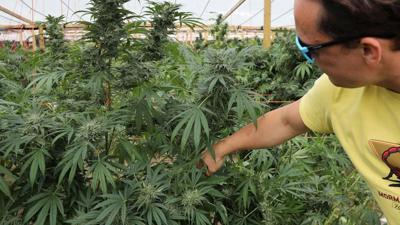
Most people know you can’t legally consume marijuana in Wisconsin, regardless of whether it’s for medical or recreational purposes.
So what’s with all those “legal weed” billboards along the highways, and how are these shops advertising delta-8 products in their windows still allowed to sell the cannabis compound?
Put simply: Because unlike delta-9, the main psychoactive compound in marijuana, other compounds like delta-8 are not regulated by the state. When concentrated and altered, these compounds can produce a similar effect on the body as pot, if only a slight one.
Most delta-8 also comes from hemp, which is legal to grow in Wisconsin.
What’s the difference between marijuana and hemp?
Marijuana and hemp are the same plant, cannabis sativa. But whether it’s legally considered marijuana or hemp comes down to how much THC, or delta-9, the plant contains. The current limit for the amount of THC content for hemp is 0.3%, which is a trace amount, UW-Madison professor of pharmaceutical history Lucas Richert said.
To keep the crop’s THC within the legal limits, farmers have to stay vigilant. Typical plant stressors like droughts, floods or temperature extremes can lead to spikes in THC content.
If the percentage of THC is higher than 0.3%, it’s considered marijuana and becomes illegal to sell. Farmers whose crops contain a percentage higher than the legal limit have to destroy them — sometimes, ironically, by burning them. Crop insurance often doesn’t cover losses when the THC potency is too high.
Assuming the THC level in the hemp is within limits, the buds can then be turned into CBD oil or further processed into compounds like delta-8 or THC-V.
Why is hemp now legal?
Hemp had been a staple crop in Wisconsin for more than 100 years before the federal government decided to regulate cannabis plants, Richert said.
But by the 1930s, most states had some form of regulation for marijuana. The federal government first put regulations and taxes on the plant in 1937 under the Marijuana Tax Act. The law allowed the government to charge an annual tax of $24 (about $551 in today’s dollars).
While the taxes were meant to reduce the amount of recreational marijuana use, they also decimated the industrial hemp industry. In 1957, the last legal hemp crop was grown in Wisconsin. By the 1970s, the federal government had listed marijuana as a Schedule I drug, an illegal drug with no accepted medical use and highly susceptible to abuse.
That all changed in 2018, when the federal farm bill carved out a legal definition for hemp for the first time, Richert said. The bill only set a legal limit for delta-9, however, leaving the plant’s other isomers and compounds, such as delta-8 and delta-10, legalized and unregulated at the federal level. In creating the definition of hemp, federal lawmakers set the legal limit of THC at 0.3%.
“It's been very recently that people are starting to think about closing some of those loopholes,” Richert said.
What’s the difference between all of these cannabis products on the market?
Delta-9 remains the main psychoactive compound people think of as marijuana, and is illegal in Wisconsin.
But by extracting cannabidiol from hemp plants and subjecting it to chemical reactions in a lab, called isomerization, scientists can rearrange the molecular structure of cannabidiol to create compounds like delta-8, delta-10, THC-V and THCA.
“You're one molecule away from a misdemeanor,” Richert said. “Those chemical differences are tiny, but they can mean really big legal consequences.”
Are compounds like delta-8 safe to consume?
Each of the products extracted from hemp plants can have differing effects on the body, and testing on those products is often less rigorous than traditional marijuana products, Richert said. In general, the psychoactive effects are milder, meaning the high and other side effects someone might feel are less pronounced than if they were ingesting marijuana.
The federal Centers for Disease Control says consumption of cannabis-related products is not risk-free. A de-regulated market without testing standards makes it more difficult for consumers to know whether what they’re consuming is safe.
The biggest misconception Richert sees around the THC market is that all of the different products with varying CBD derivatives will have the same effect on a person.
Two delta-8 products made by two different companies could have different impacts on a person because there are no testing standards.
“It's really important that the consumer have a good understanding of variability in the marketplace and that they are seeking to understand the type of products that they're they're purchasing outside of a regulated cannabis market,” Richert said. “Because we don't have a regulated personal use market in the state, we don't have a really robust way of protecting the consumers.”
What is the state doing to regulate any of this?
Lawmakers on both sides of the aisle have attempted to regulate these products.
Democrats like Gov. Tony Evers would like to see marijuana legalized and regulated for both medical and recreational use, with Evers having attempted to include it in recent budget proposals.
Republicans in the Legislature got close to allowing medical marijuana for people with chronic illnesses like cancer last session, but infighting on how to regulate it stalled the bill. Senate Republicans balked at the idea of state-run dispensaries through the Department of Health Services, arguing that was not the government’s responsibility.
Two-thirds of Wisconsinites believe marijuana should be legalized, a Marquette Law School poll from June showed.



 Posts
Posts

