Thursday, March 27, 2025

Cat drinking from sink
Microsoft abandons some data center projects. Company says Mt. Pleasant work on track
Rick Barrett
Microsoft has abandoned data center projects set to use 2 gigawatts of electricity in the U.S. and Europe in the last six months due to an oversupply relative to its current demand forecast, Reuters reported Thursday, citing an industry analyst.
The tech giant's withdrawal from new capacity leasing was largely led by the decision not to support additional training workloads from ChatGPT maker OpenAI, the analyst firm TD Cowen said in a research note obtained by Reuters.
TD Cowen did not say which projects Microsoft had abandoned.
In a statement, Microsoft said the moves will not affect the $3.3 billion data center now under construction in Mount Pleasant.
Cowen said in February that Microsoft had scrapped leases totaling "a couple of hundred megawatts" of capacity with at least two private data center operators.

"Thanks to the significant investments we have made up to this point, we are well positioned to meet our current and increasing customer demand," a Microsoft spokesperson said in an email to the Journal Sentinel.
"Last year alone, we added more capacity than any prior year in history," the statement said. "While we may strategically pace or adjust our infrastructure in some areas, we will continue to grow strongly in all regions. This allows us to invest and allocate resources to growth areas for our future. Our plans to spend over $80B on infrastructure this FY remain on track as we continue to grow at a record pace to meet customer demand."
In southeast Wisconsin, Microsoft currently has a $3.3 billion data center under construction in Mount Pleasant and a smaller one planned for Kenosha.
Earlier this month, without explanation, the company paused construction on expansion sites for the Mount Pleasant location.
“The long and short of it is that we strategically pace our infrastructure,” Microsoft spokesman Nick Michetti said in an email to the Journal Sentinel last week.
"Our commitments to Wisconsin have not changed. We’re fully on track with construction on our data center in Mount Pleasant, it’s still expected to go online in 2026, and our $3.3 billion commitment remains intact," Microsoft said in the statement to the Journal Sentinel.
"We have expansion sites in Mount Pleasant where we intend to build additional infrastructure, and we’ve already done preliminary work for those future builds."
In a response to Reuters, Microsoft said while it may "strategically pace or adjust our infrastructure in some areas, we will continue to grow strongly in all regions."
Last week, Microsoft told the Journal Sentinel it remained “fully on track” with phase one of the $3.3 billion Mount Pleasant project and that it’s still expected to go online in 2026.
Data centers house thousands of computers, in one or more buildings, linked to the outside world by fiber optic cables. They enable most everyday online activities, including social media, streaming video, banking, ChatGPT and much more.
Data centers are measured by the amount of electricity they consume.
When phase one of the Mount Pleasant project is complete, it will require the equivalent of approximately 450 megawatts of electric utility capacity, according to Microsoft, which would be less than one-half gigawatt.
Comparing data center and residential electricity usage requires rough calculations, but energy experts say 450 megawatts could meet the needs of more than 300,000 homes.
The Mount Pleasant project has been at the center of a debate over the need for a We Energies gas-fired power plant in Oak Creek.
We Energies says it needs the plant, and other gas generating facilities, to satisfy the growing demand for electricity in southeast Wisconsin, including data centers.
Critics say the demand for data centers remains uncertain and that We Energies ratepayers could be saddled with higher electric rates for gas plants that won't actually be needed.
This story has been updated with new information.
Elon Musk gives $1 million to a Green Bay voter ahead of the Wisconsin Supreme Court election
Daniel BiceAlison Dirr
Billionaire Elon Musk has thrown another $1 million into next week's Wisconsin Supreme Court race — but unlike his most recent spending on attack ads and canvassers, he said this sum went to just one voter.
Musk took to X, the social media platform he owns, to announce Wednesday evening that "Scott A." from Green Bay had won the sum for signing Musk's "Petition In Opposition To Activist Judges."
The petition was announced late last week on the X account of Musk's super PAC, America PAC. It offers $100 in cash to people who sign the election petition but does not mention a $1 million giveaway.

The PAC would then use the demographic information from the petition to make sure people vote in the high-stakes Wisconsin election on Tuesday.
The $1 million giveaway was initially announced by America PAC, though the super PAC's spending records make no mention of that payment. More than $2 million in independent expenditures in recent days have been for texting, field operations and canvassing.
In offering the large payout, Musk is resurfacing a mechanism he used in the November presidential election, when he offered $1 million sweepstakes payments to registered pro-Donald Trump voters in seven swing states — Arizona, Georgia, Michigan, Nevada, North Carolina, Pennsylvania and Wisconsin — who signed a petition.
The U.S. Department of Justice in October warned him that the actions might be illegal and Philadelphia District Attorney Larry Krasner, a Democrat, also sued to try to block the contest in Pennsylvania.
A Pennsylvania state judge in November allowed the giveaway to proceed.
Musk wrote that the next award would be announced Friday.
He has spent about $20 million backing conservative Supreme Court candidate Brad Schimel in Tuesday's election, when Schimel will go head-to-head against liberal Dane County Judge Susan Crawford.

Musk's spending has made him the single largest spender in the race that an election watchdog group has predicted could top a record-breaking $100 million in spending.
Crawford's campaign spokesman slammed Musk and Schimel over the payouts.
"It turns out that Schimel is such a bad candidate that Elon Musk will spend whatever it takes to prop up Schimel’s failing campaign in a corrupt attempt to buy influence on the Supreme Court for his company's lawsuit," spokesman Derrick Honeyman said in a statement, referencing the lawsuit by another Musk company, Tesla, against the State of Wisconsin. "It's corrupt, it's extreme, and it's disgraceful to our state and judiciary."
Schimel's campaign did not immediately respond to a request for comment, though he has said he does not control Musk's spending.
Contact Daniel Bice at (414) 313-6684 or dbice@jrn.com. Follow him on X at @DanielBice or on Facebook at fb.me/daniel.bice.
Alison Dirr can be reached at adirr@jrn.com.
Wednesday, March 26, 2025
Elon Musk leads the deep-pocketed Wisconsin Supreme Court donors by spending $19 million on race
Daniel Bice
Deep-pocketed donors are writing six- and seven-figure checks for liberal Dane County Judge Susan Crawford and conservative Waukesha County Judge Brad Schimel. The winner of the April 1 contest will determine the Supreme Court's ideological direction.
Leading the way is Elon Musk, the wealthiest individual in the world.
So far, he has dropped $19.3 million in support of Schimel, according to state campaign records.
That includes $3 million that he has given to the state Republican Party, including a $2 million gift late last week. Under state election laws, big-dollar donations have to go to the parties, which then transfer the cash to a state candidate.
In addition to his party donations, Musk's super PAC, America PAC, has spent $11.5 million on digital advertising, mailers, texts, field operations and voter turnout. The Musk-funded political nonprofit Building America's Future has also paid out nearly $4.8 million on TV ads attacking Crawford.
Candidates and outside groups are updating their fundraising totals frequently as the election nears, so many of the totals are likely to increase in the coming days.
Last week, U.S. Sen. Ron Johnson said Musk will deserve the credit if Schimel comes out on top.
"If we do win it, again, we have to thank Elon for all the support he's given this race," the Wisconsin Republican said in a live, half-hour discussion on the social media platform X, which the tech billionaire owns.
At the same time, Democrats have tried to make the contest a referendum on Musk, whose popularity has plunged since he began slicing the size of the federal government as head of President Donald Trump's Department of Government Efficiency. A recent Marquette Law School poll found Musk is viewed favorably by 41% of registered voters in Wisconsin and unfavorably by 53%.
Ben Wikler, chairman of the state Democratic Party, said in a Tuesday statement that Musk has made Schimel "his latest pawn" in his effort to amass unchecked power.
“Brad Schimel made a bad bet with Elon Musk. Across this state, the voters Brad Schimel needs are learning how he’s crawled around on his kneepads begging for cash from the world’s richest man," Wikler said, referring to Schimel's earlier joke that he was burning through kneepads while asking so many people for support and money. "It’s a bad look.”
Others giving big bucks to the state GOP to help out Schimel include Beloit businesswoman Diane Hendricks ($3.1 million); Uline co-founders Elizabeth Uihlein ($2.2 million) and Richard Uihlein ($1.6 million); and former TD Ameritrade CEO Joe Ricketts ($500,000).
Richard Uihlein, whose packaging business is based in Pleasant Prairie, has also given a little more than $4 million to Fair Courts America, making him the only supporter of the super PAC. The group has spent all of those funds on TV commercials criticizing Crawford's sentencing practices.
Overall, Schimel, a former Republican attorney general, has raised nearly $14.3 million since getting into the race in December 2023. Of that, Schimel has received about $8.8 million from the state GOP.
Crawford pulls in cash from George Soros, JB Pritzker
By contrast, Crawford has taken in almost twice that of her opponent, raising a record $26.6 million for the hotly contested election, the most ever in a judicial race in the U.S. (But conservative outside groups have raised more than liberal ones in the race, as indicated by the TV buys in the contest.)
Among her biggest donors are liberal megadonor George Soros ($2 million); Illinois Gov. JB Pritzker ($1.5 million); Milwaukee progressive Lynde Uihlein ($740,000); and Tulsa billionaires and philanthropists Lynn Schusterman ($500,000) and Stacy Schusterman ($500,000).
Records show that of Crawford's total take, $10.4 million has come from the state Democratic Party.
In announcing her fundraising haul, Crawford contrasted her support with Musk's role in the race.
“I’m grateful for the historic outpouring of grassroots support across Wisconsin from folks who don’t want Elon Musk controlling our Supreme Court," she said in a statement.
But Jacob Fischer, a spokesman for Schimel, said Crawford's latest report shows that 80% of her donors are from outside the state. He said this shows she is running "purely for the interests of national Democrats."
"She hypocritically plays the victim while receiving more money than any judicial candidate in American history, thanks to George Soros, Reid Hoffman, and JB Pritzker funneling money to her campaign," Fischer concluded.
Contact Daniel Bice at (414) 313-6684 or dbice@jrn.com. Follow him on X at @DanielBice or on Facebook at fb.me/daniel.bice.
Jury arrives at verdict in fatal shooting at Spring and State streets roundabout
Journal Times staff
RACINE — A jury has found Alejandro Sierra guilty of first degree reckless homicide in the death of 36-year-old Alexis Marie Fisher.
Fisher was found unresponsive with a gunshot wound in the roundabout at Spring and State streets on April 15, 2023. She later died from the injury.
Sierra originally was charged with first degree intentional homicide.
According to a criminal complaint, Sierra and Fisher got into an argument at a residence on Domanik Drive.
Sierra reportedly threatened to kill Fisher’s father before leaving the residence, and Fisher followed him.
The complaint said Sierra then turned and shot Fisher.
Sierra was on probation at the time of the shooting, having been convicted of operating a firearm while intoxicated, resisting or obstructing an officer and misdemeanor bail jumping.
The jury found Sierra guilty on March 19 of first degree reckless homicide with the use of a dangerous weapon after a three-day trial, according to online court records.
Sierra was being held on a $500,000 cash bond since April 2023. His bond was revoked pending sentencing.
A sentencing hearing is scheduled for May 9.
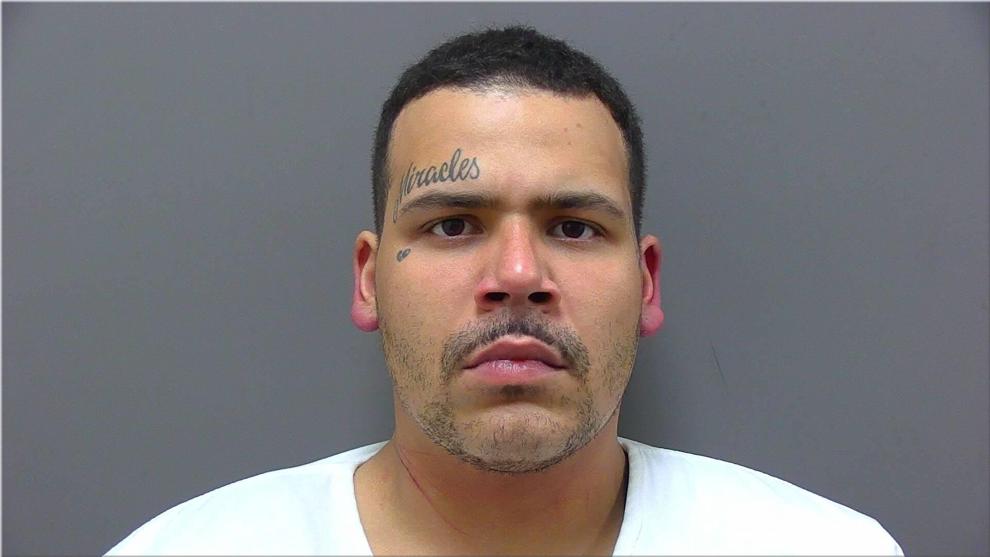 |
| Sierra |
Tuesday, March 25, 2025
Monday, March 24, 2025
Sunday, March 23, 2025
'Knocking at our door': Racine and Kenosha at risk for measles outbreaks
Caroline Neal
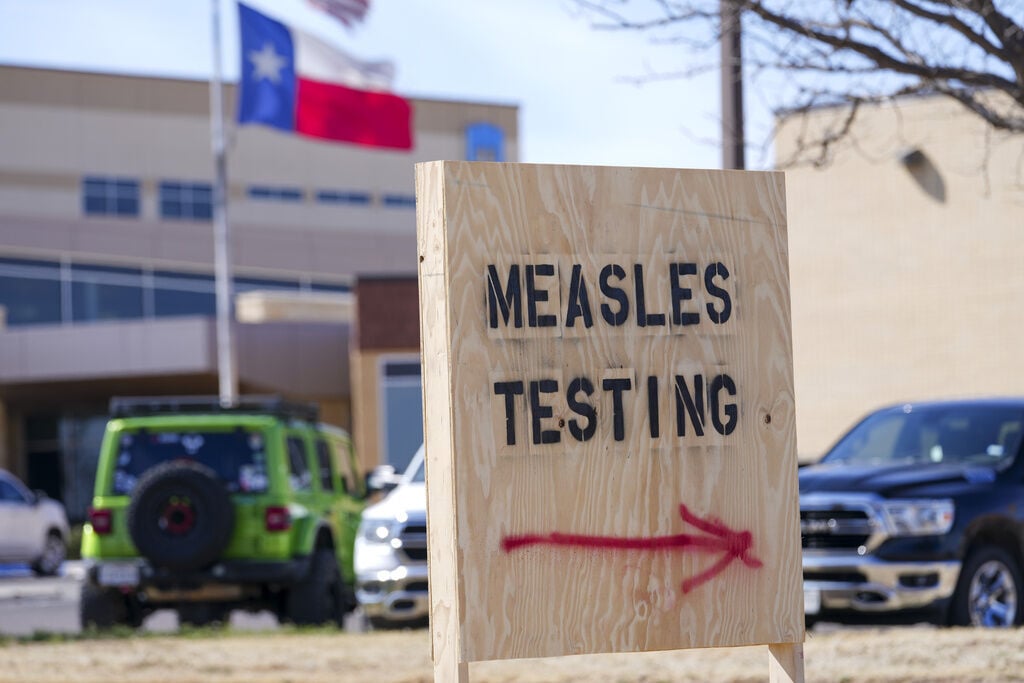 |
A sign is seen outside of Seminole Hospital District offering measles testing, Feb. 21, in Seminole, Texas. Though there have been no confirmed measles cases in Wisconsin, Dr. Greg DeMuri said that proximity does not matter as much today. "It's only a plane ride away," he said. |
RACINE — As measles spreads through communities in Texas, New Mexico and other states, Racine and Kenosha vaccination rates remain below the necessary 95% vaccination threshold for herd immunity.
A report from the Centers of Disease Control and Prevention found that Wisconsin children had the second lowest measles vaccination rate at 84.8%, with only Alaska ranking lower at 84.3%.
As of March 14, the United States has seen 301 cases of measles, 95% of which were unvaccinated or did not have a known vaccination status.
In February, an unvaccinated school-aged child in Texas died from measles, marking the first U.S. death from the disease in a decade. An adult infected with measles in New Mexico also died, but the cause of death is still being investigated.

DeMuri
“We’re just waiting for it to hit Wisconsin,” said Dr. Greg DeMuri, a professor in the Division of Infectious Diseases at the University of Wisconsin. “It’s really spreading throughout the United States. This has happened before, even with higher vaccination rates. It’s happened because we haven’t hit that magic 95%.”
What is measles?
According to the CDC, measles is a disease that can cause high fever; cough; runny nose; red, watery eyes; and a rash. It can occur at any time of the year.

An electron microscope image of a measles virus particle. As of March 14, there have been a total of 301 confirmed measles cases in the United States, with most being in Texas and New Mexico
Spreading through the air, measles is one of the most highly contagious diseases of the vaccine-preventable diseases and those most people are familiar with, DeMuri said.
“One way to conceptualize that is if you’re on an airplane and you’re sitting in first class, and somebody has measles in the rear of the plane, you can get measles from breathing air that’s recirculated through that airplane,” he said. “It’s not just sitting close to them, getting coughed on, that kind of thing, like it is with flu.”
Although Texas and New Mexico are far away from Wisconsin, proximity matters less now, DeMuri said.
“It only takes a traveler from a place where there’s been a case. Somebody visits family members in another state where there’s a case, brings it back home,” he said. “You’re contagious before you develop the rash and before you get sick, and so it can be spread to others silently.”
At a local level
Data from the Wisconsin Department of Health Services shows that in 2023, 74% of 5- and 6-year-old children in Racine County had received two or more doses of the measles, mumps and rubella vaccine.
That same year, 69% of 5- and 6-year-old children in Kenosha County had received two or more doses of MMR.
For DeMuri, counties with low vaccination rates like Racine and Kenosha are “ticking time bombs.”
“The virus is really knocking at our door,” he said.
Racine and Kenosha do not have the lowest vaccination rates in the state: The same data showed Vernon County at 48%, and Clark County is at 46%.
Though other counties have lower rates, many also benefit from being rural and more spread out, whereas residents from Racine and Kenosha frequently travel between the two.
“It’s going to cause a lot of leakage of virus over from one to another,” DeMuri said. “If it does hit either one, it’s going to be pretty quick before the other is going to get it.”
Schools at risk
Schools, too, are at risk for outbreaks.
According to the CDC, there is a higher chance of an outbreak in schools with more unvaccinated children, and the outbreak size increases with the percent of unvaccinated children.
Each year, Wisconsin schools are required to report how many students have met the minimum immunization requirements, are in the process of meeting requirements, are behind schedule, have a waiver, or have no immunization record or waiver.
DHS data from the 2023-24 school year shows that 86% of all Racine Unified School District students met the minimum vaccination requirements, and the remaining are in progress, are behind schedule or have a waiver.
Still, 92.54% were in compliance with state immunization law, which allows students to be in the process of receiving their vaccinations or have a signed waiver.
Stacy Tapp, chief of communication and community engagement at RUSD, said the district does not have a plan “at this time” to increase the percent of students in compliance with state immunization laws.
According to the Racine County Public Health Division, just over 5% of students in the county requested immunization waivers, marking an increase of almost a full percent from the 2019-20 school year to the 2024-25 school year.
“Non-medical waivers are the largest contributor, accounting for almost 90% of all student immunization waivers in 2024-2025 across Racine County,” a Racine County spokesperson said.
Of Kenosha Unified School District students, 88% have met the minimum requirements, and the remaining are in progress, are behind schedule, or have requested a waiver. However, 99.26% of KUSD students are in compliance with state law.
According to KUSD, there has been an increase in waivers for religious, medical or personal convictions, which are permitted within state immunization requirements.
Indeed, DHS data shows 6.1% of Wisconsin students during the 2023-24 school year have a waiver.
“It is important to keep in mind that waivers typically increase when the state requirements change,” a KUSD spokesperson said. Over the past few years, Wisconsin’s requirements have changed. “It appears that waivers tend to increase during the years when these types of changes occur.”
KUSD sends notices on the 15th and 20th days of school when students are not in compliance.
The district sends electronic communications through Virtual Backpack, its family e-newsletter, and its student information system as well as flyers from the Kenosha County Public Health Department on childhood immunizations.
In the spring, KUSD sends reminders to guardians for the next school year.
Spread of misinformation
In a statement, Kenosha County’s communication director Joe Potente said “Health Officer Lori Plahmer reports that the county is continuing to conduct its normal surveillance and that we currently have no reported (measles) cases here.”
According to Racine County Public Health Division, low MMR vaccination rates in Wisconsin are a “significant concern.”
Racine County Public Health has run PSAs to spread accurate information and to encourage people to stay current on vaccinations.
The county also informs families through its home visiting programs, during which a nurse or educator answers questions and helps families make a plan to get up to date on vaccines.
“We encourage families to get their vaccines at their healthcare providers office, local health departments, or local pharmacies,” the county said. “We also offer vaccines for uninsured or underinsured children at our clinic in Sturtevant.”
According to DeMuri, declining vaccination rates can be attributed to a combination of factors, including misinformation on social media that has caused a swing in attitudes against vaccines.
“There’s been this really promulgation of vaccine information throughout social media, and that just propagates,” DeMuri said. “People send it to their kids, their grandchildren, their brother, sister, and then that misinformation gets out there.”
For DeMuri, one way local officials can combat misinformation is “meeting people where they are” and running social media campaigns.
The Covid-19 pandemic also played a role in this, he said, because there was more misinformation about vaccinations.
“That has bled over into mistrust for other vaccines,” said DeMuri, adding that he’s noticed declining vaccination rates for other vaccines, especially for live vaccines like MMR that are more prone to misinformation.
Following the work of Andrew Wakefield in the 1990s, MMR has also been “picked on” as a possible cause of autism, he said.
“(Wakefield’s) work was completely discredited,” DeMuri said. “There have been multiple, large-scale epidemiologic studies from very, very trustworthy researchers that have shown there’s absolutely no risk between measles vaccine and autism.”
DeMuri also recommends people talk with their health care providers.
“Go to your doctor, your nurse practitioner, physician’s assistant — you trust them with your life, really — and ask their opinion about this,” he said.
A Racine County spokesperson said vaccine hesitancy among adults is “likely the biggest contributing factor” to low vaccination rates in the county.
“We as a society are inundated with information and it is often difficult to filter out misinformation and identify reputable sources. It only takes a seed of doubt to potentially sway someone’s decision to vaccinate,” Racine County Public Health Division wrote. “It is our goal to be the source of trusted information for our community so they can make the best decision possible for themselves and their families.”



 Posts
Posts

